
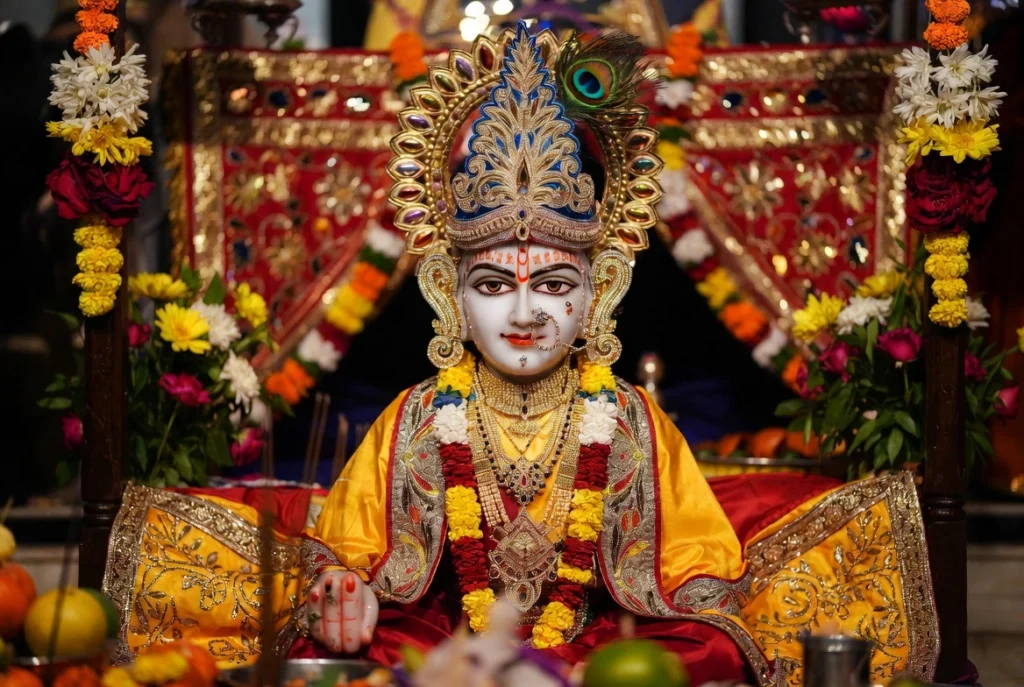
The Banke Bihari Temple is a well-known Hindu shrine honoring Lord Krishna as Banke Bihari – an image blending Radha and Krishna – found in Vrindavan, part of Mathura district in Uttar Pradesh, India. Close to the Nidhivan forest, it’s a key stop for followers of the Bhakti path, attracting huge crowds every year, particularly during events such as Janmashtami or Holi, when energy runs high with color, song, and prayer.
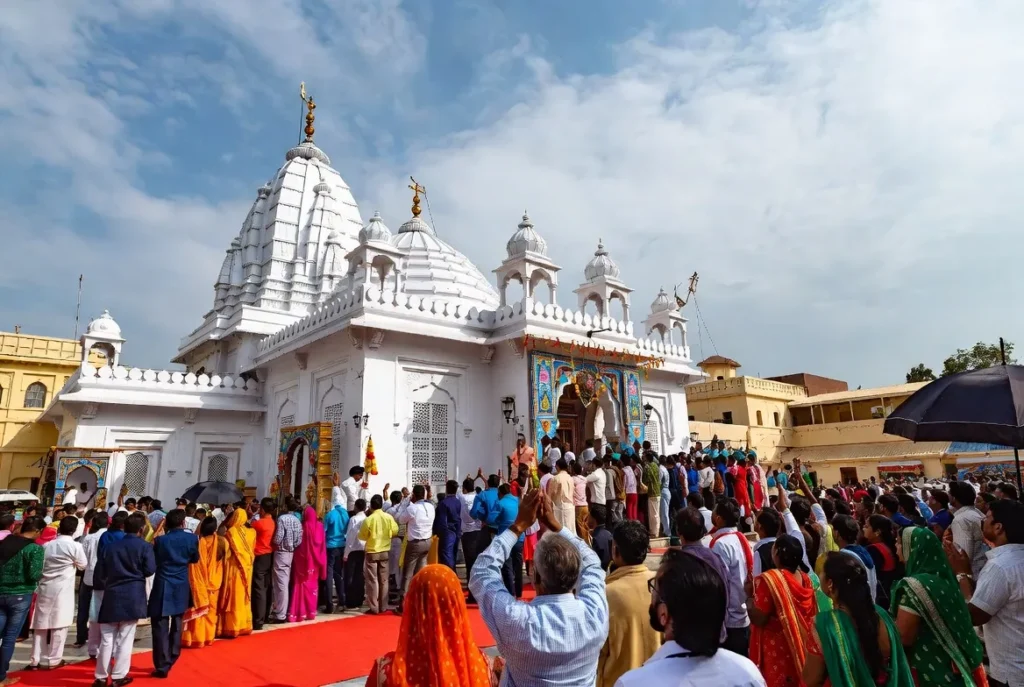
Built back in 1864 using classic Rajasthani design, the building shows off detailed red stone walls, curved doorways, along with layered levels that add to its holy charm.
The temple began in the 1500s – Swami Haridas, a singing holy man who taught Tansen at the Mughal court, saw the image of Banke Bihari appear during deep music-based prayer in Vrindavan’s quiet Nidhivan grove. At first, people honored it as Kunj Bihari in a tiny hut inside that wooded area; but as more came, the demand grew. Because of rising interest, the Goswamis built today’s main structure in 1864 to fit everyone showing up.
Locals say the statue formed on its own, not carved by hands, showing Krishna bent in three graceful curves – a sign of his mischievous charm – with Radha quietly part of the form.
Renowned for deep spiritual meaning in Vaishnavism, this shrine captures rasa lila – the playful bond between Radha and Krishna – drawing visitors who hope for answered prayers or inner peace. What sets it apart from other shrines? No regular aarti happens here because devotees believe the idol’s presence is so powerful that staring too long feels improper; rather than lamps, they briefly reveal the image behind a curtain every few minutes, echoing how the celestial pair hides then shows affection, all while devotional songs play nonstop along with constant bell sounds.
Oversight falls to the Uttar Pradesh Shri Banke Bihari Ji Temple Trust (set up in 2025), which enforces tight rules managing footfall, given its fame as a top destination in Vrindavan even as construction like the Banke Bihari Corridor moves forward aiming to protect sacred spaces.
Overview
Location and Accessibility
The Banke Bihari Temple sits in Vrindavan, a town in Mathura district, Uttar Pradesh, India – coordinates are around 27.5783° N, 77.6983° E. About 12 kilometers out from Mathura’s main area, it’s also some 150 km north of New Delhi, nestled into the holy terrain near the Yamuna River, just 1.5 km off to the east. Found right in the heart of old Vrindavan, it stands close to major spots like Nidhivan – the place where people say the idol was first honored – while being only a short walk from the Radha Raman Temple, located nearly 1 km away.
In August 2025, officials in Uttar Pradesh set up the Shri Banke Bihari Temple Trust so someone could handle daily operations and growth plans. Then, by October that year, workers opened the temple’s old storage vault for the first time in 54 years – finding rare items showing deep cultural roots.
Getting to the temple’s easy using different ways to travel – no entrance fee, but people often leave a small donation. The closest big train stop is Mathura Junction, roughly 12 kilometers off; from there, hop on an auto, grab a cab, or ride a city bus to Vrindavan – it takes around half an hour.
That rail hub runs regular services to key spots like Delhi. If you’re coming by vehicle, just follow the Yamuna Expressway from Delhi; it’s nearly 150 clicks and clocks in at close to three hours whether driving or taking a coach. Once you’re in Vrindavan, short rides on electric rickshaws or pedal-powered ones help weave through tight pathways right up to the doorstep.
Also Read This:- Trimbakeshwar Temple: Complete Spiritual Journey Guide 2025
The nearest spot for flying in is Kheria Airport (AGR) near Agra, about 53 km to the southeast – only a few local flights land there. After that, travelers often pick Delhi’s Indira Gandhi Airport (DEL), sitting 160 km up north, which links to way more places. From both spots, arranged cabs or public buses usually get you to Vrindavan within one to three hours. Expect packed streets, particularly when big events like Holi or Janmashtami roll around – lines stretch out, roads change flow now and then.
By October 2025, the temple started using better ways to handle people: no special entry tickets anymore, plus longer opening times so everyone moves easier. To skip stress, it helps showing up when things are calmer.
Deity and Iconography
The main figure at Banke Bihari Temple is called Banke Bihari – a combined image carved from one dark stone, showing Radha and Krishna as a pair. Instead of two separate figures, they’re shown together, suggesting how closely linked they are. You won’t see Radha beside him; her presence blends quietly into his shape, hinting at unity. This oneness reflects deep love that never fades, key in the devotional path focused on these two. While it’s just one statue, it carries meaning beyond its form – love joined forever.
The image shows Krishna standing in tribhanga – curved gently at neck, waist, and knee – giving off a lively grace that draws love; this form is called Banke Bihari because “banke” means bent thrice, while “bihari” points to one who enjoys deeply. In his hands rests a flute, seen by many as sweet like honey, representing sacred music. His eyes are partly shut, pulling you in with soft magnetism, whereas the tilt of his feet adds movement, making the stance feel alive yet inviting.
The dark stone figure, said to appear on its own, wears fresh flower wreaths, peacock feathers, while delicate ornaments highlight its youthful charm. Sometimes a covering hides it now then, softening its powerful presence – so no lamp ritual shows, just quick views that deepen worshipers’ feelings.
History and Legends
Origin and Discovery
The story of Banke Bihari’s beginnings goes way back to the 1500s, tied closely to Swami Haridas – a respected spiritual singer who was born in 1478 CE in a village called Haridaspir, close to today’s Aligarh in Uttar Pradesh. Coming from the old Gargacharya line, he was seen by many as the living form of Lalita Sakhi, one of Radha’s most trusted companions; so it made sense that he left behind normal life young, diving deep into love-filled worship through song and stillness among Vrindavan’s holy woods. Part of the eight key poets known as ashtachhap followers in Vallabhacharya’s path, his writings focused on rasopasana – feeling divine joy via Krishna’s lively, dancing forms.
The story of Banke Bihari’s beginning goes way back to the 1500s, linked closely to Swami Haridas – a holy singer born in 1478 CE near today’s Aligarh, in a place called Haridaspur. Coming from the old Gargacharya line, he was seen by many as Lalita Sakhi reborn, one of Radha’s most trusted companions. From a young age, he walked away from normal life, choosing instead deep spiritual focus, singing hymns under Vrindavan’s trees. Part of the eight chosen poets in Vallabhacharya’s circle, he wrote soulful songs centered on rasopasana – loving Krishna through beauty and divine play.
At first, people kept the murti under a small roof made of straw in Nidhivan, where Haridas and his group could pray privately, calling it Kunj Bihari – the one who lives in forest clearings. Seeing how special it was, Haridas wrote many devotional songs for this image; some still exist today through the Haridasi line, shaping heartfelt worship ways.
With more folks coming to honor it, the idol moved around Vrindavan over time – not staying put after tensions flared up between Haridasi monks and gosvamis – till they finally settled it somewhere lasting. Each year on the fifth day of Margashirsha, believers mark that moment with Prakatyotsav, remembering when the divine revealed itself here.
Temple Construction
The current Banke Bihari Temple in Vrindavan went up in 1862, giving the idol a permanent home after years of being honored in changing spots. That shift happened once the image moved from Nidhivan – where it first appeared back in the 1500s – to a modest local shrine prior to landing in the finished hall. A few records suggest work wrapped by 1864, hinting construction may have unfolded in stages.
The build began with the Goswamis – family line of Goswami Jagannath, Haridas’s brother from the 1500s – who’d always taken care of worship duties. Instead of just leading, they shaped it through old teachings passed down from Haridas, pulling in craftspeople who mixed Rajasthani and Mughal styles naturally. Because the plot had already been given years before, construction kicked off smoothly; being placed in Dusayat Mohalla meant visitors could reach it easily.
Funding for the temple mostly flowed in through the Goswami group along with contributions from well-off followers and visitors – totaling roughly Rs 70,000 – which highlighted a growing wave of Vaishnava temples rising across Vrindavan under British rule. That time brought back Hindu sacred spaces even while colonizers held power; groups such as the Goswamis used deep devotional ties to fund projects independently of kings or courts. Old tales met present-day faith in this effort, turning the site into a key center for honoring Krishna.
Religious Significance
Scriptural References
The Banke Bihari figure comes from old stories about Krishna’s joyful, mischievous side – tales full of dance, charm, or quiet moments under trees. These scenes pop up in sacred writings like the Puranas, where Krishna moves with grace among friends and lovers. In one part – the 10th Skandha of the Bhagavata Purana – he dances with ease, body curved just so, matching how Banke Bihari is shown today: bent in three places, calm yet lively. That sway? It signals deep delight amid nature’s sheltered spots. Meanwhile, the Brahma Samhita calls him “śyāmaṁ tri-bhaṅga-lalitaṁ” – dark-skinned, beautifully bent thrice, holding a flute, dressed with feather flair – a look that lines right up with what people now worship.
In the Brahma Vaivarta Purana, this coming together is described as a destined timeless joining – Radha forms from Krishna’s left side, showing the spirit of the gopis’ pure affection, which lifts his image to stand for deep emotional worship in Vaishnava circles.
While the Vedas barely mention Krishna as one divine form among many, later Puranas shift focus, making him key – not through grand cosmic roles, yet as the ultimate playful lord full of charm.
Bhakti writings add depth by using poems that spotlight Banke Bihari’s image. Instead of just telling stories, they sing about him – like Swami Haridas did back in the 1500s. This poet-saint wrote songs, including one called “Banke Bihari Ki Aarti,“ highlighting how Krishna leans sideways while playing flute under trees in Vrindavan. He pulled scenes from ancient tales to show a heartfelt kind of devotion full of emotion.
Through musical verses set in melodies such as Vibhas, he painted Banke Bihari as someone who roams forest groves, stirring love and joy. In a similar way, Surdas described Krishna in his book Sursagar – not dry facts but vivid images – of a dark-complexioned boy whose curved stance and sweet music charm everyone around. These lines capture an irresistible attraction much like what you see in statues of Banke Bihari today.
Theological views see Banke Bihari as showing gopi-like feelings – devotion that echoes the selfless love described in the Brahma Vaivarta Purana; this highlights how Radha and Krishna belong together, seen by many as peak spiritual dedication.
Though not mentioned directly in ancient Vedas, he gains importance later on, especially within devotional writings from the medieval era. His presence grows stronger through poems composed around the 1500s, shaped by devotee-poets such as Surdas – one of the eight revered writers – who turned old legends about Krishna’s playful moments in Vrindavan into heartfelt songs people could feel deeply. Today, followers in rasik groups connect these traditions back to Swami Haridas, whose musical expressions helped spread the image widely.
Association with Bhakti Tradition
The Banke Bihari Temple is at the heart of the Haridasi tradition, part of the larger Bhakti path that values deep feeling in devotion, especially to the playful bond between Radha and Krishna. Started by Swami Haridas – a holy figure from the 1500s – this lineage leans into personal connection, using song and stillness to draw near the divine. The idol here shows Krishna in a captivating pose, full of charm and grace. Seen as an earthly form of Lalita Sakhi, one of Radha’s dearest attendants, Haridas found the sacred image while lost in spiritual music under the trees of Nidhivan in Vrindavan. That moment, rooted in heartfelt search, gave rise to the temple’s living legacy.
Though Hita Harivansh Mahaprabhu started the Radha Vallabh Sampradaya at about that time, it’s deeply linked to the Haridasi path – both focus on honoring Radha-Krishna together in joyful, endless love instead of complex ceremonies. Because of Swami Haridas’s influence, this temple became key for devotions built around raslila drama, where Krishna shown mid-sway, bent in three places, reflects how closely tied the two deities are, encouraging a similar attention on beauty and feeling in worship. That link highlights how the place mixes song and spiritual thrill, since Haridas wrote many dhrupad lines for Banke Bihari, bringing classical tunes into Vaishnav practice.
The temple’s spiritual vibe shaped various Vaishnava paths – like Pushtimarg started by Vallabhacharya, or Gaudiya tradition spread by Chaitanya Mahaprabhu – all coming together in 1500s Vrindavan to back sincere worship over rigid rituals. Haridas’s impact, along with his resting place close to the shrine, highlights total trust and song-based devotion, nudging different groups toward closer, individual bonds with God.
Culturally, the temple deeply influenced art across Braj – sparking dhrupad music, Pichwai visuals showing Krishna’s playful acts, also writings full of raslila spirit. Each year, gatherings here keep devotion alive through song and dance, bringing followers who feel Haridas’s passion firsthand while carrying forward Braj’s role as a heartland of Vaishnav expression.
Architecture and Layout
Structural Design
The Banke Bihari Temple shows classic Rajasthan design, yet hints of Mughal flair pop up – like curved arches and flower-like details. Its outer walls, built from red sandstone, feature delicate carvings alongside latticed windows that let air flow through while adding visual charm. Inspired by old havelis from the region, it blends craftsmanship typical of 1800s Braj culture without sticking to rigid rules or flashy trends.
Built using red sandstone from local Rajasthan quarries along with marble, the temple stands on a solid base built to handle shifting ground near the Yamuna River. It’s got several stacked levels instead of just one flat roofline. Inside, there are open column-lined spaces where people meet and pray together. A closed yard allows room for religious parades and rituals. Fancy entrances show off flower patterns carved into stone, plus detailed inserts made of marble, lacquered wood, or golden touches – each piece adding meaning without clutter. These details highlight its purpose: not only a place to look at but also to connect deeply through faith.
The temple slowly grew bigger to handle more visitors – courtyards got wider, new side gates opened during the 1900s; now in the 2000s, projects like the Banke Bihari Corridor (started near 2023, still going by 2025) help people move easier while protecting old structures.
Sanctum and Idol Placement
The heart of the Banke Bihari Temple, called the garbhagriha, is a quiet inner room lit just enough to cast shadows around the main figure. Instead of bright lights, soft glows shape a sense of closeness and wonder. Inside this shadowed space sits the key statue – a single black stone image of Lord Krishna. Rather than standing straight, it curves gently at three points, showing him in a relaxed, joyful pose known as tribhanga.
The statue looks straight at worshippers, creating closeness – still, it sits high on a platform showing its sacred status. A stitched drape, called the parda, slides in front now and then, revealing the image just for seconds before hiding it once more; this custom limits staring too long at the powerful figure, thought to cause deep trance or momentary blankness. Touching the image isn’t allowed, which keeps its ghostly, untouchable feel alive – representing Radha and Krishna joined as one.
The space inside stays safe thanks to a curtain that controls how much you see of the divine – just enough presence, not too intense. Around it, artwork shows Krishna’s playful moments, like dances in meadows, painted right onto the walls. These images pull people into devotion while bringing Vrindavan’s timeless woods to life nearby.
Worship Practices
Daily Rituals
The daily routine at Banke Bihari Temple gives visitors short peeks of the god through a moving curtain, keeping his young, magical vibe alive. It’s open for viewing from 7:00 AM to 12:30 PM and again from 4:15 PM to 9:30 PM in summer (April–September); during winter (October–March), it runs from 8:00 AM to 1:30 PM and 4:00 PM to 9:00 PM – this schedule stands as of October 2025. Every few minutes – between five and seven – the curtain over the dark stone statue slides open then shut, giving quick moments of sight so people don’t get too stirred up by staring too long, since he’s seen as lively and boyish. While most temples have group prayers out front, this one skips them during visiting times so the idol isn’t bothered; instead, caretakers do quiet rituals hidden behind the fabric.
Darshan Timing Table
| Season | Morning Timings | Evening Timings |
|---|---|---|
| Summer (April–September) | 7:00 AM – 12:30 PM | 4:15 PM – 9:30 PM |
| Winter (October–March) | 8:00 AM – 1:30 PM | 4:00 PM – 9:00 PM |
Curtain Darshan Routine
| Aspect | Details |
|---|---|
| Curtain Opening Frequency | Every 5–7 minutes |
| Purpose | Short peeks to prevent overwhelming emotions |
| Idol Nature | Seen as lively and boyish |
| Aarti During Darshan | Skipped to avoid disturbance |
| Ritual Type | Quiet rituals performed behind the curtain |
Priests, Traditions & Daily Worship
The Goswamis – priests born into families linked to Swami Haridas and part of the Nimbarka tradition – handle key ceremonies; like dressing the deity at dawn, known as shringar aarti, also putting him to rest at night through shayan aarti, done quietly out of sight, since the idol is seen as a sleeping infant.
These caretakers come from around eight to ten lineages inside that spiritual group, keeping alive day-to-day worship shaped by Haridas’s personal devotion, passing down deep faith across generations. Worshippers join in by leaving blooms, treats, or ornate fabrics called chadars at set spots, later brought forward when food offerings happen.
Family-based musicians sing sacred songs throughout the rites, adding warmth to prayer times while skipping loud tools such as conches or bells – an unusual habit preserved on purpose to keep the space calm, mysterious.
Priests & Ritual System
| Element | Description |
|---|---|
| Priest Community | Goswamis (descendants linked to Swami Haridas) |
| Tradition | Nimbarka Sampradaya |
| Number of Lineages | Around 8–10 family lines |
| Main Ceremonies | Shringar Aarti, Shayan Aarti |
| Ritual Style | Quiet, behind-curtain activities |
| Idol Perception | A sleeping infant during night rituals |
Devotee Offering & Participation
| Activity | Details |
|---|---|
| Offerings | Blooms, treats, ornate chadars |
| Placement | Put at designated spots |
| Food Offerings | Butter, sugar treats |
| Prasad | Peda distributed to all equally |
| Music | Family musicians, soft devotional songs |
| Restrictions | No conches or bells to keep space calm |
Crowd Management & Offerings
To handle the big rush of people, the temple uses a regular line with no special access, keeping darshan smooth even when packed – updated back in September 2025. After prayers, followers get prasad like peda sweets; these come from the morning offering that also includes butter and sugar treats, showing equal grace for everyone. During festivals though, things shift a bit – with bigger rituals and more activity.
Crowd Management
| Aspect | Description |
|---|---|
| Access System | Single regular line (no VIP entry) |
| Purpose | Smooth darshan flow even during heavy crowds |
| Update | System standardized in September 2025 |
| Festival Days | More rituals and increased activity |
Festivals and Celebrations
Banke Bihari Temple in Vrindavan holds big festivals every year, pulling crowds from all over India – each one bringing loud chants, colorful setups, or shared prayers. Because of stories about Radha and Krishna, these occasions turn the place lively, filling it with energy, unique outfits on idols, or longer prayer times. After a Supreme Court move in 2025, a temporary panel took charge of logistics such as handling people flow; meanwhile, family-trained priests kept up the sacred routines.
Janmashtami pops up in August or September to mark when Krishna was born. At midnight, folks act out his birth, rocking the idol softly in a fancy swing – this is called jhulan seva – which shows how moms care for their babies. People don’t eat for a full day, then end their fast only after special prayers at night. The temple gets decked out with bright colors, marigolds, diyas, and floor art that cheer on Krishna’s coming. It pulls in close to half a million guests who sing devotional songs while walking together near the shrine.
Holi happens every March, stretching across a few days around the Braj area. At one temple, they mark Phoolon ki Holi on Rankbhari Ekadashi – no colored powder here; instead, priests toss flower petals at visitors, recalling how Radha and Krishna once played. When the big festival day hits, folks parade the statue of Banke Bihari through Vrindavan’s lanes while splashing water, tossing gulal, dancing to local tunes. This shows just how deep the temple is tied to Braj’s lively customs. Lathmar Holi mostly goes down in Barsana close by, but its energy spills over – the temple joins in with shared color games pointing to sacred love stories.
Radhashtami celebrates Radha’s birth each September, falling on Bhadrapad Shukla Ashtami. Devotees perform abhishekam – washing the idol with care – while musicians take part because they see it as something deeply meaningful. Instead of just songs, there are also dances like kathak filling the temple grounds. Crowds gather not only to watch but to remember how close Radha and Krishna have always been.
After Diwali, during Govardhan Puja in October or November, people prepare a big spread of 56 veg dishes – called chhappan bhog – stacked like a hill of food in front of the idol, thanking Krishna for shielding villagers in the old legend. Chants echo as priests present the meal, then hand out bits of it to worshippers, showing how nature provides when honored.
From April through July, the Phool Bangla celebration fills the temple’s jagmohan with detailed flower arches – fresh blooms arranged into soft patterns. These decorations create a shady, sweet-smelling space for night visits lasting more than three months, ending on Shravan Amavasya. Instead of regular ornaments, the god wears garlands made entirely of blossoms, bringing relief when it gets hot. People show their faith by placing flowers as offerings, one after another.
Festivals sometimes feature parades similar to rath yatras – like during Holi, when people carry the god’s litter through busy roads filled with singing and dancing, creating a shared journey vibe. Big days can draw as many as half a million visitors, so temple stays open longer – for instance, 7 till 12:30 and again from 4:15 to 9:30 in warmer months – with tighter safety steps such as public warnings, fencing, plus cops on site, all part of updates rolled out by officials in 2025. Events like kathak dances or group chanting add color to rituals, mixing worship with creative flair.
FAQ
Q. What is special about the darshan at Banke Bihari Temple?
The darshan is unique because the curtain opens every 5–7 minutes, giving devotees short glimpses of the deity. This tradition preserves the lively, playful nature of Banke Bihari and prevents devotees from becoming overwhelmed.
Q. What are the Banke Bihari Temple timings in 2025?
The timings differ by season:
Summer (April–September): 7:00 AM – 12:30 PM and 4:15 PM – 9:30 PM
Winter (October–March): 8:00 AM – 1:30 PM and 4:00 PM – 9:00 PM
Q. Why is aarti not performed publicly during darshan?
Public aarti is avoided because it may disturb the deity. All key rituals are performed quietly behind the curtain to maintain a peaceful, mystical atmosphere.
Q. Who performs the rituals at Banke Bihari Temple?
The rituals are carried out by Goswami priests belonging to families linked to Swami Haridas. They follow the Nimbarka tradition and manage all ceremonies like shringar aarti and shayan aarti.
Q. What offerings can devotees bring?
Devotees typically offer flowers, sweets, butter, sugar treats, and decorative cloths (chadars). These are placed at designated spots before being taken inside during offerings.
Q. Is there VIP darshan at Banke Bihari Temple?
No. The temple follows a single-line entry system with no special or VIP darshan, ensuring equal access for all devotees. This system was last updated in September 2025.
Q. What type of prasad is given at the temple?
The prasad includes peda sweets and items from the morning food offerings such as butter and sugar mixtures.
Q. How does the atmosphere inside the temple remain peaceful?
Musicians sing soft devotional songs without using bells, conches, or other loud instruments, helping maintain a calm and mysterious environment.
Q. Does the temple routine change during festivals?
Yes. Festivals include expanded rituals, additional offerings, and increased activity inside the temple.