
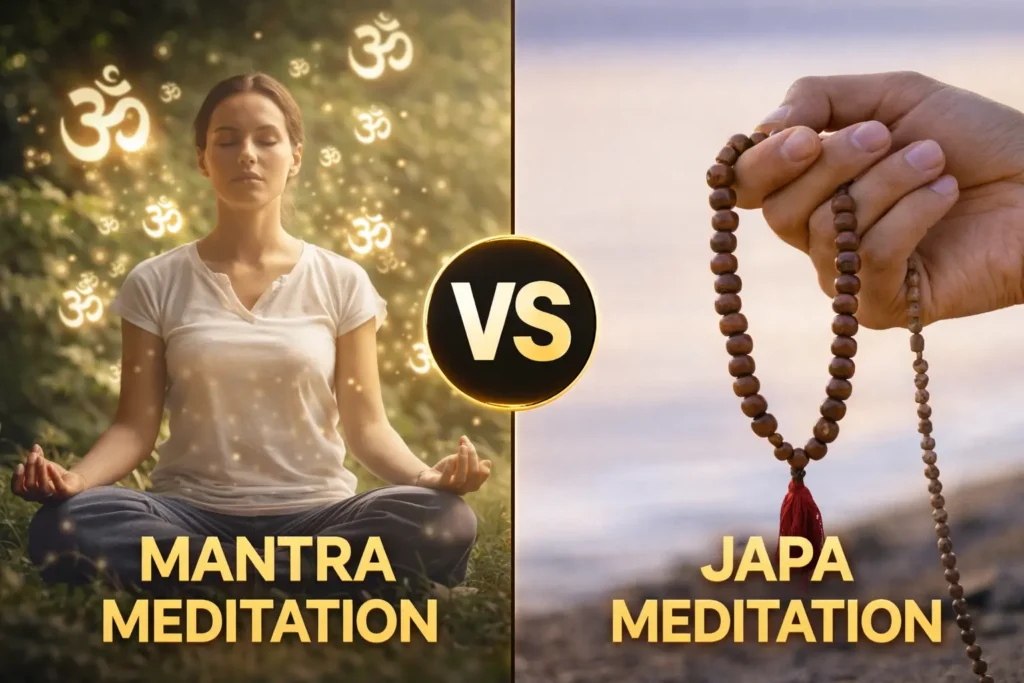
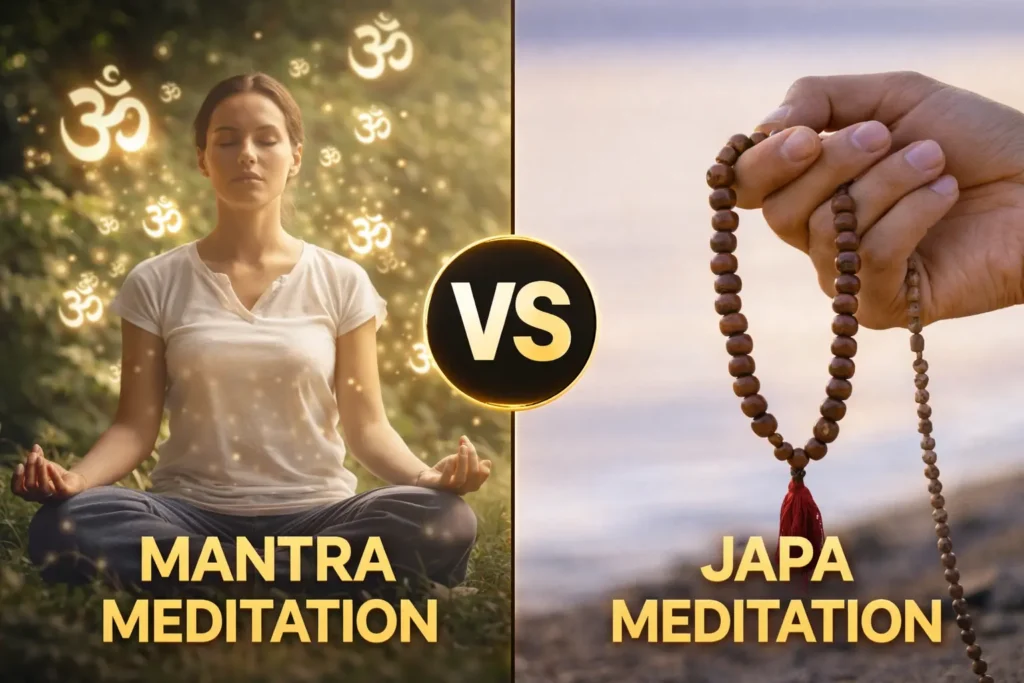
Many beginners in spiritual practice often feel confused between mantra meditation and japa meditation. Both practices involve repeating a mantra, yet they are not exactly the same. Understanding the difference between mantra meditation and japa meditation helps you choose the practice that suits your mindset, lifestyle, and spiritual goal.
This guide explains the differences in a simple and clear way, especially for beginners.
Table of Contents
What Is Mantra Meditation?
Mantra meditation is a meditation technique where a mantra is used as a focal point to calm the mind and develop concentration. The mantra may be repeated silently, softly, or mentally as part of a meditative process.
The main purpose of mantra meditation is:
- Mental stillness
- Improved focus
- Reduction of thoughts
- Inner calm
In mantra meditation, the meditative state is primary, and the mantra acts as a tool to reach that state.
What Is Japa Meditation?
Japa meditation is the practice of repeating a mantra a specific number of times, traditionally counted using a mala of 108 beads. The repetition itself is the core practice.
The purpose of japa meditation is:
- Discipline
- Devotion
- Rhythm and repetition
- Gradual spiritual transformation
In japa meditation, repetition and count are important, not just silence.
If you want a complete foundation, you may first understand what is japa meditation and how beginners can practice it.
Core Difference Between Mantra Meditation and Japa Meditation
The main difference lies in intention and structure.
- Mantra meditation focuses on meditative awareness
- Japa meditation focuses on repetition and discipline
Both practices complement each other and are often practiced together.
Mantra Meditation vs Japa Meditation
| Aspect | Mantra Meditation | Japa Meditation |
|---|---|---|
| Primary Focus | Meditation and awareness | Repetition and count |
| Counting | Not mandatory | Important |
| Use of Mala | Optional | Commonly used |
| Structure | Flexible | Structured |
| Best for | Mental calmness | Discipline and devotion |
| Beginner Friendly | Yes | Yes |
| Duration | Time-based | Count-based |
| Goal | Inner stillness | Consistent spiritual practice |
How Mantra Meditation Is Practiced
In mantra meditation:
- Sit comfortably
- Close your eyes
- Repeat the mantra mentally
- Let thoughts settle naturally
There is no fixed count. The session ends when the practitioner feels calm and centered.
How Japa Meditation Is Practiced
In japa meditation:
- Choose a mantra
- Decide a repetition count (often 108)
- Repeat the mantra steadily
- Use a mala or counter
The session is complete when the chosen count is finished.
To understand why 108 is commonly used, you can read about the importance of 108 in japa meditation.
Role of Devotion in Both Practices
Devotion plays a stronger role in japa meditation, especially in Naam Japa, where the divine name itself is repeated with feeling.
Mantra meditation may be practiced with or without devotional emotion, depending on the practitioner.
Which Practice Is Better for Beginners?
Both practices are suitable for beginners, but the choice depends on personality:
Choose mantra meditation if:
- You prefer silence
- You want mental calmness
- You like flexible practice
Choose japa meditation if:
- You like structure
- You want daily discipline
- You enjoy chanting
Many beginners start with japa meditation and gradually experience mantra meditation naturally.
Can Mantra Meditation and Japa Meditation Be Combined?
Yes. In fact, many practitioners naturally combine both.
Example:
- Begin with japa meditation (108 repetitions)
- End with silent mantra meditation
This creates a complete and balanced practice.
Examples of Mantras Used in Both Practices
Common mantras include:
These mantras can be used in both mantra meditation and japa meditation.
Role of Counting Tools
Traditional japa uses a 108-bead mala. Modern practitioners may prefer digital tools.
Using a Mantra Counter Online helps maintain accurate repetition without breaking focus, especially for beginners.
Common Misunderstandings
- “Mantra meditation and japa meditation are the same”
- “Counting is compulsory for meditation”
- “One is better than the other”
Both practices serve different purposes and can complement each other beautifully.
Which One Should You Practice Daily?
There is no single correct answer.
You may:
- Practice japa meditation daily for discipline
- Use mantra meditation when you need calmness
- Combine both based on your mood and time
Consistency matters more than technique.
Conclusion
The difference between mantra meditation and japa meditation lies mainly in structure and intention. Mantra meditation focuses on inner stillness, while japa meditation emphasizes repetition and discipline.
Both practices are powerful, beginner-friendly, and rooted in ancient tradition. By understanding their differences, you can choose—or combine—the practice that best supports your spiritual journey.
For structured daily chanting, many seekers rely on TemplePedia’s Naam Japa Counter to complete their practice without distraction.
FAQ – Difference Between Mantra Meditation and Japa Meditation
Q1. What is the main difference between mantra meditation and japa meditation?
The main difference is structure: mantra meditation focuses on awareness and calmness, while japa meditation emphasizes repetition and counting.
Q2. Is japa meditation a type of mantra meditation?
Yes. Japa meditation uses mantra repetition, but it follows a count-based, disciplined approach, whereas mantra meditation may be time-based and flexible.
Q3. Which is better for beginners: mantra meditation or japa meditation?
Both are beginner-friendly. Japa meditation suits those who prefer structure; mantra meditation suits those who prefer silence and flexibility.
Q4. Do I need a mala for mantra meditation?
No. A mala is optional for mantra meditation. It is more commonly used in japa meditation to count repetitions.
Q5. Is counting necessary in japa meditation?
Yes. Counting is an important part of japa meditation, traditionally done with 108 repetitions.
Q6. Can both practices be done together?
Yes. Many practitioners start with japa meditation and then continue with silent mantra meditation for deeper calmness.
Q7. Do both practices use the same mantras?
Yes. Mantras like Om Namah Shivaya, Radhe Radhe, and the Maha Mrityunjaya Mantra can be used in both practices.
Q8. Which practice is more devotional?
Japa meditation is generally more devotional, especially in Naam Japa, while mantra meditation focuses more on mental stillness.
Q9. How long should each practice be done?
Mantra meditation is usually time-based (5–20 minutes), while japa meditation is repetition-based (27, 54, or 108 times).
Q10. Can I practice mantra meditation without spiritual belief?
Yes. Mantra meditation can be practiced for focus and calmness even without devotional belief.
Difference Between Mantra Meditation and Japa Meditation, Difference Between Mantra Meditation and Japa Meditation, Difference Between Mantra Meditation and Japa Meditation, Difference Between Mantra Meditation and Japa Meditation, Difference Between Mantra Meditation and Japa Meditation, Difference Between Mantra Meditation and Japa Meditation