
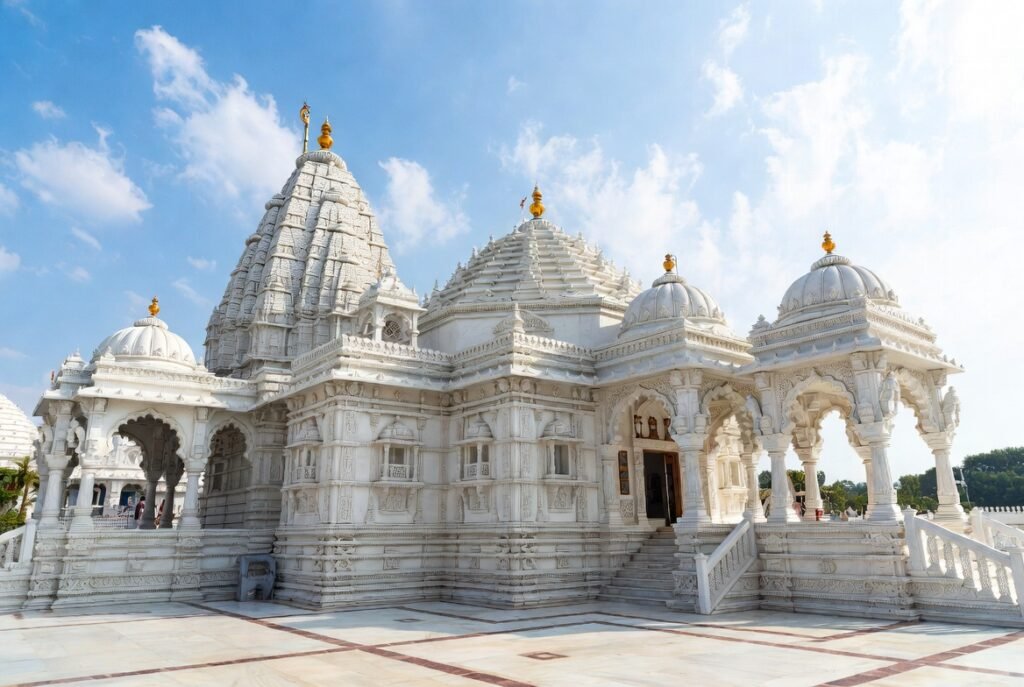
Prem Mandir stands as a big Hindu temple area in Vrindavan, located in Mathura’s region of Uttar Pradesh, India, built around the deep bond shared by Radha Krishna alongside Sita Ram, showing endless loyalty through its design. Run with spiritual direction from Jagadguru Kripalu Maharaj – the fifth leader honored in this lineage – the place got launched slowly over three days starting February 15, reached full opening on the 17th in 2012, wrapping up more than ten years since groundwork began on January 14, 2001. Sitting across a wide stretch of 54 acres near the edge of town, it’s looked after by the nonprofit group Jagadguru Kripalu Parishat while costing close to 150 crore rupees (roughly $23 million) during construction.
The design of Prem Mandir shows amazing detail, with a tall three-level build – 125 feet up, 190 front to back, 128 side to side – including the flag, resting on solid granite dug 20 feet down so it stays firm. Instead of regular stone, the whole outside is made from top-grade white Carrara marble from Italy; each of the 84 wall sections carries fine carvings showing moments from Radha Krishna’s divine play, while verses by Jagadguru Kripalu Maharaj are etched across different spots.
When you step inside, full-size marble figures of Radha Govind and Sita Ram stand as main icons, watched over by statues of eight earlier Jagadguru’s, along with revered Rasik saints and Ashta Maha Sakhis- all placed around a walking lane so people can move close and see every small carving. Besides the temple itself, there’s green space with gardens, water jets synced to music, plus an evening light-and-sound display after sunset that lights up the artwork, adding depth to the devotional mood when Bajan Sandhya begins.
Called the “Temple of Divine Love,” Prem Mandir is deeply meaningful in Vaishnava belief – drawing countless followers each year who come to feel the devotion shown in Radha Krishna’s playful acts, while its structure aims to keep those memories alive far into the future. Open every day, darshan starts at 5:30 AM until noon then resumes from 4:30 PM till 8:30 PM, featuring morning and night aartis; entry costs nothing so everyone can join, making it welcoming for prayer or quiet thought. Still growing, new additions like a vast 73,000 sq ft dome hall without pillars – and room for 25,000 – show how central this place has become spiritually within Vrindavan.
Prem Mandir Vrindavan- Quick Info
| Category | Details |
|---|---|
| Temple Name | Prem Mandir, Vrindavan |
| Location | Vrindavan, Mathura District, Uttar Pradesh |
| Darshan Timings (Morning) | 5:00 AM – 12:00 PM |
| Darshan Timings (Evening) | 4:30 PM – 8:30 PM |
| Aarti Timings | 6:30 AM & 7:00 PM |
| Musical Fountain Show | 7:00 PM – 7:45 PM (Daily) |
| Entry Fee | Free (No Ticket Required) |
| Best Time to Visit | Evening (LED lighting), Weekdays, Winter Season |
| Nearest Railway Station | Vrindavan Railway Station – 3.5 km |
| Nearest Major Station | Mathura Junction – 12 km |
| Nearest Airport | Agra Airport – 75 km, Delhi IGI Airport – 160 km |
| Founded By | Jagadguru Shri Kripalu Ji Maharaj |
| Year of Inauguration | 2012 |
| Time Required for Visit | 1–2 Hours |
| Photography Rule | Allowed only in outer premises (Not inside temple hall) |
| Famous For | Marble architecture, Radha Krishna Leelas, Night lighting, Fountain Show |
History
Founding and Construction
Prem Mandir came from Jagadguru Shri Kripalu Ji Maharaj, a well-known spiritual guide who focused on love for Radha Krishna as the way to connect with the divine – this became the main reason behind the temple’s design. Back in 1946, when he was just 24, he made a promise to create a large temple after being moved by his trip to Rang Ji Temple. Instead of waiting, he pushed forward with support from Jagadguru Kripalu Parishat (JKP), an organization he started in 1972 that mixes charity, education, and devotional practice. JKP took charge of leading the effort, handling every part while working toward spreading devotion and helping those in need.
A spot near Vrindavan, spread across 54 acres at the edge of Mathura district in Uttar Pradesh, got picked for the temple grounds – big enough to fit a massive layout but still close to Braj’s holy places tied to Krishna’s legends. The choice mixed practical space demands with the deep spiritual vibe of Vrindavan Dham.
Work started when Jagadguru Shri Kripalu Ji Maharaj placed the first stone on January 14, 2001 – thousands watched, kicking off a huge task lasting nearly a dozen years. Instead of regular materials, they brought in high-quality white marble from Italy; roughly 1,000 expert craftworkers shaped it piece by piece across different stages. Money came entirely from free-will gifts to JKP, showing how deeply people cared about making this sacred vision real.
Inauguration
The opening of Prem Mandir took place across three days – February 15 to 17, 2012 – a milestone after more than ten years of building work, filled with classic Vedic customs. Jagadguru Shri Kripalu Ji Maharaj guided the event, dedicating the site with deep feeling, calling it the realization of a spiritual dream meant for humanity. Starting on the 15th, activities kicked off with Kalash Yatra, a parade celebrating holy vessels tied to abundance and clarity. Next day brought Mandir Prakshalan, a cleansing rite washing down the grounds so they’d be ready for sacred presence. Things climaxed on the 17th via Pran Pratishtha – the act of awakening the idols using detailed mantras, gifts, and calls directed by Shri Kripalu Ji Maharaj.
Thousands flocked to the big gathering, bringing loud joy through songs, movement, and shared chants tied to the temple’s message of spiritual connection. Such numbers called for careful planning – makeshift setups appeared, while teams guided people smoothly despite the high energy around.
After it opened on 17 February 2012, crowds started showing up fast – making Prem Mandir a top spot for devotion right away. By 2014, during its second-year celebration, things got even busier – with brighter night lights and longer viewing hours because more people kept coming. As of 2015, the place began getting noticed for shaping culture; travel campaigns included it to show how it helped bring new life to Vrindavan’s traditions.
Architecture and Design
Structural Features
Prem Mandir in Vrindavan stands tall as a double-level temple inside a wide 54-acre area, built so people can walk around it for prayer or meet in big groups, with clear zones going up and out. Its primary structure runs 190 feet long, stretches 128 feet across, then rises 125 feet high – this count includes the banner on top of the middle tower – giving it strong visual weight in the surroundings.
The build uses high-quality Italian Carrara marble from top to bottom – picked because it lasts long, lets light through, yet handles weather tough spots. That stone sits on a strong 20-foot-thick base made of granite, keeping everything steady for years ahead. These materials mix old-school Indian brickwork methods with modern tech like fortified inner frames, holding up the temple’s stacked design while still looking clean and true.
The inner design focuses on a main chamber down below for key gods, while upstairs holds more prayer spots – connected through wide corridors guiding movement and ceremonies on each floor. A set path around the raised base helps worshippers walk the outer edge in an orderly way.
Architects shaped Prem Mandir using the Nagara form common across north India, while adding touches from Rajasthan and Gujarat – noticeable in the rounded domes and groups of pillars – that boost strength and balance how it looks. Though rooted in tradition, its layout uses spacing smartly; this mix keeps support solid without sacrificing beauty. Curves flow into uprights through careful placement, where design choices reflect regional flair but still feel unified overall.
Sculptures and Artistic Elements
The sculptures at Prem Mandir stand out because of detailed marble work, crafted from bright white Italian stone spread across walls, ceilings, pillars, and inner spaces. Instead of simple designs, they show Hindu gods alongside complex flower motifs plus stories centered on prem bhakti – spiritual love – which matches the shrine’s focus on Radha and Krishna.
A key detail? The 84 outer panels – each one hand-carved – to show moments from Radha and Krishna’s lives, like the Ras Leela, holding up Govardhan Hill, or stealing butter. Devotees get a visual journey through stories rooted in texts such as the Shrimad Bhagavatam. Inside, ceilings and walls carry on with shallow carvings of sakhis tending to the divine pair. Woven patterns and curling flowers add subtle charm, giving the space a light, dreamy feel. You’ll also find inscriptions of devotional verses written by Jagadguru Kripalu Maharaj along the walls. These aren’t just for looks – they invite quiet thought and deeper understanding.
Figuring out those creative touches took around 1,000 skilled workers from different parts of India – each spending more than a decade shaping stone by hand the old-fashioned way. The marble came from Italy’s mines; its smooth texture made it perfect for tiny, meaningful carvings showing love and faith. Because of this blend of time, skill, and material, the temple stands as a powerful example of spiritual craftsmanship.
Landscape and Surroundings
Gardens and Pathways
The Prem Mandir area spreads across 54 acres, with carefully designed green spaces playing a key role in the calm outdoor vibe – neat grassy patches mixed with bright seasonal flowers bring out a peaceful, sacred feeling. Along both sides of the main path, thick foliage frames creative setups like statues, carvings, and scenes showing Lord Krishna’s playful moments, adding depth to the devotional atmosphere visitors experience.
Winding walkways made of marble guide you along garden trails, helping folks circle the temple just like they’ve done for ages. These routes feature detailed stone carvings showing moments from Krishna’s journey, so people can connect with tales of devotion as they move slowly through quiet spaces. Trees found locally create cool spots under their leaves, giving shade while blending right into the landscape. Paths aren’t just functional – they pull everything together without trying too hard.
The garden design takes ideas from the legendary woods of Vrindavan – those tied to Krishna’s tales – bringing to life thick green areas that echo the holy thickets where divine moments happened. Run by Jagadguru Kripalu Parishat (JKP), the group behind the temple, upkeep continues nonstop so the grounds keep their beauty and peaceful vibe no matter the season
Water Features and Illumination
The water displays at Prem Mandir are mostly made up of a high-tech fountain system inside the temple grounds – these sync streams with spiritual songs, bringing out a deep sensory vibe. Instead of just spraying up, the water moves in lively rhythms, bouncing to the beat while bright lights shift colors around them. Around these flows, white Italian marble shapes the scene, using curves and edges that guide your eye along walkways and fronts. Water wraps around major parts of the design, mixing stillness with flow so one doesn’t overpower the other.
Central ponds – like those near the main fountains – act like mirrors at night, bouncing back the temple’s lit-up outline, which boosts visual charm while adding a calm layer in front of the big marble structure. Right after dark, this mirrored look really stands out, since the surface grabs shifting light patterns dancing across carved details and statues. The layout makes sure these touches fit naturally into the surroundings, enhancing rather than distracting from the sacred atmosphere.
Also read this:- Meenakshi Amman Temple- Best Temple in Madurai
The lighting setup at Prem Mandir uses modern LEDs along with laser effects to brighten the whole site once it gets dark, turning the pale marble into a lively display that brings out every carved detail. Colors shift smoothly, usually timed to match stories of Radha and Krishna shown through beams and music playing together. Tech is fine-tuned so statues and patterns stand out just right, blending well with fountains and pools underneath.
A main nighttime highlight is the everyday lights-and-sound event – featuring music-spouting fountains, glowing LEDs, along with laser displays – that turns tales from Radha-Krishna myths into a 30–45 minute act, pulling big audiences thanks to its mix of worship vibes and creative flair. It runs at different times depending on season: 7:30 to 8 p.m. during warmer months (April–Sept), while shifting to 7 to 7:30 p.m. when it cools down (Oct–Mar), boosting the temple’s feel as a hub where tech meets devotion.
Religious Significance
Deities and Worship Practices
The heart of Prem Mandir sits on the first level, holding statues of Radha and Krishna – representing sacred affection. Upstairs, another chamber features Sita and Ram, adding depth to its spiritual theme drawn from ancient Indian tales. Those figures were put in place when the temple opened widely between Feb 15 and 17, 2012.
Daily routines focus on organized chanting sessions and viewing ceremonies helping followers express faith. Right after sunrise, about 5 a.m., Mangala Aarti kicks things off – meant to wake up the gods.
Then comes Shringar Darshan plus chants at 8:30 a.m. where statues get dressed up alongside moments of silent respect. Around noon, folks gather again for Shayan Aarti at twelve o’clock along with rich meal presentations. Later in the day, another chant session happens at 4:30 p.m. – this one leading into night rituals ending with Shayan Aarti at 8:10 p.m., tucking the deities in. Food offerings roll out at set hours – for example, 6:30 a.m. and 11:30 a.m. early on, then once more at 5:30 p.m.; gates sometimes shut briefly while these are being arranged.
Gifts play a big role here – people bring flowers, necklaces of blooms, or basic things like fruit when they come to see the deity, keeping old-school Hindu rules about clean hands and honest hearts. After the fire ritual, folks pass around prasad, usually sweet treats or meals touched by holiness, so everyone gets a taste of grace. The whole place runs on deep affection for the divine, using daily chants and group songs that echo through the rooms with heartfelt praise. Off to the side, calm corners invite you to sit alone, think deeply, or just breathe slowly while surrounded by peaceful stone walls.
A unique part of prayer time at Prem Mandir is the nightly light show that brings Krishna’s playful acts to life using glowing statues joined with timed music and motion, kicking off at 7 PM during colder months (Oct–Mar) or 7:30 when it’s warmer (Apr–Sept), beginning in 2025, running half an hour. The scenes spotlight major moments from Radha-Krishna tales, blending bright visuals with daily worship practice.
Philosophical and Cultural Role
Prem Mandira shows what “prem” really means – divine love at the heart of Jagadguru Shri Kripalu Ji Maharaj’s message, where he pushed for rasik bhakti instead of empty rituals. His approach highlights a deep bond with Radha Krishna, rooted in old texts like the Vedas and Bhagavata Purana. Through works such as Prem Ras Madira and Prem Ras Siddhant, Kripalu Ji brought back the idea that souls find purpose through pure affection toward God. Inside the temple, detailed scenes of Radha Krishna’s playful moments act like stories told in stone, pulling visitors into this emotional worship style. These images guide people toward bhakti yoga – not complex, just heartfelt – and present it as the easiest way to inner joy.
In its culture-focused mission, Prem Mandir keeps Vaishnava ways alive – carving Kripalu Ji’s teachings into stone and art, so Vrindavan stays rooted as Krishna’s devotional heart. Built by Jagadguru Kripalu Parishat (JKP) back in ’72, this site pulls travelers worldwide, linking people through shared faith while boosting local spiritual visits; take 2020 to 2025, nearby property prices jumped more than triple thanks to crowds seeking that loving sacred vibe. These efforts also cover festivals like Makar Sankranti, tied closely to traditional Vaishnava practices, strengthening connections within the group.
Also read this:- Kashi Vishwanath Temple: A Complete Travel Guide to the Spiritual Heart of Varanasi
On the learning side, the temple shares Kripalu Ji’s ideas using art shows plus talks run by JKP – these help regular guests and serious learners grasp prem bhakti basics. Outside the temple walls, JKP runs schools and colleges where ancient beliefs mix into everyday classes instead of staying locked in books. By 2025, Prem Mandir still shapes new waves of devotional practice – not just as a place to visit but as a spark for deep emotional worship. It fuels worldwide efforts and gatherings that reshape classic Vaishnava customs so people from all backgrounds can connect without losing meaning. This way, pure divine affection stays alive even while culture shifts around it.
Events and Activities
Daily Rituals
Prem Mandir in Vrindavan follows a set routine every day, focusing on honoring Radha and Krishna through rituals held two times daily so visitors can join in. By 2025, the temple welcomes people from 5:00 AM until noon, then again from 4:30 PM to 8:30 PM each evening, timing it around early prayers at dawn and bedtime chants near nightfall.
The morning kicks off at 5:00 AM with mangala aarti plus parikrama – walking around the shrine while lighting lamps to welcome blessings. By 6:30 AM, food offerings called bhog are presented; then the main chamber shuts for a short time so things can be set inside. At 8:30 AM, darshan restarts along with singing and prayers, giving visitors a chance to see the idols up close. Another meal offering happens at 11:30 AM, wrapping up the early schedule just before noon rituals begin and doors seal shut at 12:00 PM. Come evening, worship picks back up at 4:30 PM through prayer chants and viewing ceremonies. Around 5:30 PM, more bhog goes in front of the deities.
Then at 7:00 PM, people circle the temple again while songs play out loud. Finally, nighttime aarti takes place at 8:10 PM, signaling it’s time for the gods to rest. Lines during darshan stay controlled thanks to helpers guiding foot traffic based on how busy it gets.
People should wear clothes that cover their shoulders and knees when taking part in ceremonies – items like kurtas or sarees work well, even if they’re not required. Shoes have to come off before going inside, no exceptions. You can take pictures in outdoor spots or while doing darshan, however snapping photos inside the holy area isn’t allowed so things stay peaceful. Helpers around the site will show you where to stand, how to behave, plus let you know it’s best to keep quiet and act considerate.
The main ceremony times stay pretty much the same all year, yet small tweaks happen now and then depending on the season – take the night water display with music, it runs from 7:30 to 8 in summer, though during winter it’s earlier, say 7 to 7:30; when storms pop up, outdoor walks might shift inside, but that doesn’t occur often.
Major Festivals
Prem Mandir lights up during big Hindu festivals – Janmashtami, Holi, or Radhashtami – with unique ceremonies and live acts that pull huge groups from everywhere, even overseas. Crowds pour in thanks to festive vibes boosted by devotion-filled routines. To handle the rush, teams gear up well ahead, setting things right for smooth visits. Extra guards show up, keeping everyone safe without hassle. Devotees share sacred food, handed out widely, building a sense of togetherness through shared moments.
Janmashtami celebrates the arrival of Lord Krishna, kicking off with rituals right when midnight hits – devotees gather for sacred chants plus a moment to honor his birth. Bright lights cover the temple, joined by fresh blooms and creative setups that match the festive spirit, while prayer sessions go longer than usual along with music shows and folk dances playing out across several spots around the grounds. By dusk in 2025, close to six million people had arrived in Mathura and Vrindavan for the event, blowing past last year’s crowd which sat near four and a half million, thanks partly to big-name temples like Prem Mandir pulling in massive waves of visitors – all under tighter watch from more than three thousand officers using cameras in the sky and on poles.
Holi brings lively scenes of color-filled play, as people meet near the temple for joyful events with gulal, fragrant rose petals, or dancing that shows Krishna’s mischievous moments. Bright lights on the temple form a glowing scene, pulling crowds into green-friendly gatherings buzzing with chants and tunes. Getting ready means adding space for folks to move, also handing out meals by passing prasad between those taking part.
Radhashtami celebrates Radha’s birthday with colorful decor, long prayer sessions, devotional singing, followed by lively parades showing her deep bond with Krishna – events often lasting late into the night. Ever since the temple opened in 2012, more people show up each year, proof of how well-known Prem Mandir has become; the 2025 festivities keep building on that momentum, backed by smooth crowd control and shared food for everyone.
Visitor Information
Location and Accessibility
Prem Mandir sits just outside Vrindavan, in Mathura district of Uttar Pradesh, India – found along Raman Reti Road near 27.57°N 77.67°E. Around 3 km separates it from the well-known Banke Bihari Temple, so visitors touring holy spots can reach it without hassle. Instead of blending into crowded streets, this spot stays quiet, tucked slightly apart from busy zones. Yet it still fits naturally within the region’s spiritual vibe.
Getting to Prem Mandir from Delhi by car means covering nearly 150 kilometers using the Yamuna Expressway – usually takes between two and a half to three hours if traffic’s smooth. Closest train stop? That’s Mathura Junction, just about 11 km off – autos or taxis can take you straight to the temple from there. No airport right nearby; Agra’s one is the nearest at some 60 klicks away. Otherwise, fly into Delhi’s main international hub, which sits roughly 150 km out.
In Vrindavan, you can reach Prem Mandir by hopping on an auto-rickshaw, e-rickshaw, or bus – these run often from spots like the main market and don’t cost much for quick trips. Parking’s wide open here if you’re driving a car, riding a scooter, or arriving by coach – with small charges, say Rs.100 for autos – and it handles tons of vehicles every day thanks to big lots nearby. By 2025, road links around the area got better; plus, there’s fresh work going up since April that year: a large parking structure meant to fit more than 300 cars across several floors, helping ease crowding and let travelers move easier.
Timings and Amenities
Prem Mandir in Vrindavan doesn’t charge any fee – everyone can enter at no cost. You’re welcome every day for darshan, starting early: 5:00 AM brings Aarti and Parikrama. After Bhog around 6:30 AM, things pause till 8:30 AM when Darshan resumes with another Aarti. This lasts up to noon before closing briefly. Later on, doors open again from 4:30 PM straight through 8:30 PM. These times follow regular rituals including evening aartis and food offerings. During big events like Janmashtami, hours might stretch longer because more people show up.
Also read this:- Badrinath Temple – 10 Sacred Facts & Ultimate Travel Guide
On-site, you’ll find tidy toilets along with no-cost shoe storage, making things easier for worshippers and travelers alike. Most areas are wheelchair-friendly – ramps plus marked walkways help those who need them get around without hassle. Inside, souvenir spots sell devotional items, literature, and keepsakes tied to Radha-Krishna worship. At the same time, veggie eateries hand out prasad and basic food made under clean conditions.
Visitor help includes guided walks in English or Hindi, so you can check out the temple’s design and meaning. Medical basics are covered by staff around, while a lost-item desk sits near the front gate for things left behind.
Frequently Asked Questions
Q. What is Prem Mandir famous for?
Prem Mandir is famous for its stunning white marble architecture, beautiful lighting show, Radha-Krishna divine artworks, and peaceful devotional atmosphere. It is one of Vrindavan’s most visited temples.
Q. Who built Prem Mandir in Vrindavan?
Prem Mandir was built by Jagadguru Shri Kripalu Ji Maharaj. The temple was inaugurated in 2012 and is managed by Jagadguru Kripalu Parishat.
Q. What are the darshan timings of Prem Mandir?
Prem Mandir is generally open from 5:00 AM to 12:00 PM and again from 4:30 PM to 8:30 PM. Timings may change on festivals.
Q. Is there any entry fee for Prem Mandir?
No, entry to Prem Mandir is completely free for all devotees.
Q. What is the best time to visit Prem Mandir?
Evenings are the best time, especially after sunset, when the temple glows with LED lighting and the gardens look divine.
Q. How far is Prem Mandir from Vrindavan Railway Station?
Prem Mandir is around 3.5 km from Vrindavan Railway Station and easily reachable by auto, e-rickshaw or taxi.
Q. Is photography allowed inside Prem Mandir?
Photography is allowed only in the outer premises, not inside the main temple hall.
Q. What is the story behind Prem Mandir?
Prem Mandir represents divine love of Radha-Krishna and Sita-Ram. It showcases important leelas through carvings and murals, teaching the concept of “Prem Bhakti.”
Q. Does Prem Mandir have a light show?
Yes, there is a beautiful musical fountain & light show every evening, usually between 7:00 PM – 7:45 PM.
Q. How much time is required to visit Prem Mandir?
On average, devotees spend 1–2 hours, including darshan, photo spots, and the evening light show.