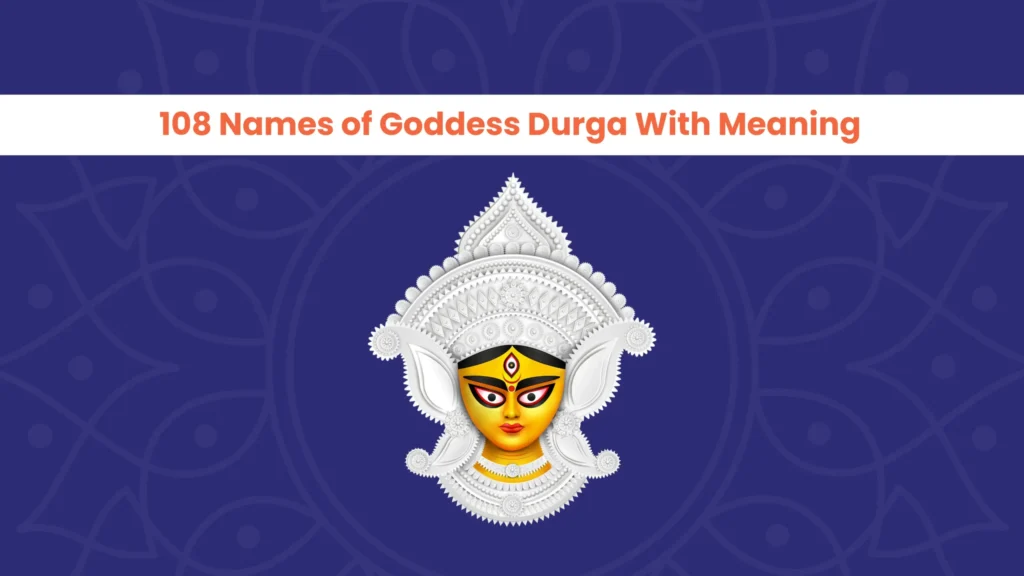
Have you ever stood before the magnificent idol of Maa Durga during Navratri, looking into her glowing, compassionate eyes, and felt an instant shiver of absolute devotion run down your spine? In that sacred moment, surrounded by the heavy scent of burning camphor, the rhythmic beating of the dhak, and the loud chants of her glory, all your earthly problems seem to shrink. Your inner worries, fear of failure, financial anxieties, and emotional exhaustions suddenly melt away into her divine embrace.
In our unpredictable, stressful lives, we often feel completely defenseless against negative environments, toxic people, and internal mental demons like self-doubt or deep anger. When life feels like an unending battleground, where do you turn for raw protection, mental resilience, and absolute peace?
The answer lies hidden deep within the ultimate manifestation of cosmic energy- Maa Durga.
The ancient scriptures reveal that chanting the 108 names of goddess durga, widely recognized as the Durga Ashtottara Shatanamavali, is not just a ritualistic hymn. It is an intensely potent spiritual weapon. Each name is a divine key that opens up specific energetic frequencies within your aura, shattering obstacles and inviting success. Let’s dive deep into this complete sacred guide to understand the profound meaning behind each name and how this chanting sadhana can fundamentally rewrite your destiny.
Table of Contents
The Spiritual Significance of Chanting Maa Durga’s Names
To truly grasp why the 108 names of goddess durga hold such unmatched transformative potential, we have to look closely at the origin story of the Supreme Cosmic Mother. When the terrifying demon Mahishasura gained immense power and drove the gods out of their heavenly abode, none of the individual male deities could stop him. In absolute surrender, Lord Brahma, Lord Vishnu, and Lord Shiva merged their primeval cosmic fires. From this blazing collective energy emerged Maa Durga—the invincible Shakti.
[Brahma's Light] + [Vishnu's Radiance] + [Shiva's Flame] ──> MAA DURGA (Invincible CosmiThe word Durga itself translates to “the one who is untamable, a fortress that cannot be breached.” When you read or chant the 108 names of goddess durga, you are mentally walking through the multi-dimensional aspects of the universe.
Why exactly 108 names? In Vedic astrology, the number 108 holds profound significance. There are 12 zodiac houses and 9 primary planets ($12 \times 9 = 108$). Similarly, there are 27 lunar mansions (Nakshatras), each split into 4 distinct quarters ($27 \times 4 = 108$). Therefore, by chanting the 108 names of goddess durga, you are actively tuning your personal biological energy field with the entire cosmic timeline, dissolving negative planetary blocks instantly.
Also Read This:- “Best Rudraksha for Money and Success: 5 Sacred Beads for Wealth”
108 Names of Lord Krishna (With Meaning)
The Complete 108 Names of Goddess Durga With Meaning
Here is the complete, deeply authentic list of the 108 names of goddess durga, along with their literal meanings and the spiritual vibrations they bring to your life:
| No. | Sacred Name | Literal Meaning & Spiritual Blueprint |
| 1 | Durga | The Invincible One; she who eliminates all suffering. |
| 2 | Shantani | The eternal provider of deep peace and tranquility. |
| 3 | Shambhavi | The divine companion of Lord Shambhu (Shiva). |
| 4 | Bhayatihari | She who completely shatters the root of all fears. |
| 5 | Kalyani | The blissful bringer of ultimate auspiciousness and wealth. |
| 6 | Ardhachandrini | The goddess who wears the elegant crescent moon like a crown. |
| 7 | Bhavani | The eternal mother who gives life to the entire cosmos. |
| 8 | Bhuvaneshwari | The supreme ruler of all visible and invisible worlds. |
| 9 | Mahatapa | She who practices immense, absolute spiritual penance. |
| 10 | Manah | The very essence of the cosmic mind and pure consciousness. |
| 11 | Buddhi | The source of brilliant intellect and higher wisdom. |
| 12 | Ahankara | The controller of the ego and individual identity. |
| 13 | Chittarupa | The goddess who resides in the form of pure thought. |
| 14 | Chita | The cosmic fire that drives intelligence and awareness. |
| 15 | Chiti | The multi-dimensional divine consciousness itself. |
| 16 | Sarvamantramayi | The absolute soul of all sacred sounds and mantras. |
| 17 | Satta | The ultimate truth; the base of all active existence. |
| 18 | Satyanandaswarupini | She who is the purest embodiment of eternal truth and joy. |
| 19 | Ananta | The boundless one; she who has no beginning or end. |
| 20 | Bhavini | The beautiful source of emotional connection and empathy. |
| 21 | Bhavyaswarupa | The grand goddess who embodies magnificence and beauty. |
| 22 | Sadgati | The divine guide who grants liberation and the right path. |
| 23 | Shambhavi | The daughter of King Shambar; lover of pure meditation. |
| 24 | Devamata | The ultimate cosmic mother of all divine celestial beings. |
| 25 | Chinta | The manager of focus; she who removes toxic mental worries. |
| 26 | Ratnapriya | She who loves glittering jewels, representing material wealth. |
| 27 | Sarvavidya | The storehouse of all forms of knowledge and fine arts. |
| 28 | DakshaKanya | The daughter of King Daksha; the primordial Sati. |
| 29 | DakshaYajnaVinashini | The fierce destroyer of Daksha’s proud, egoistic sacrifice. |
| 30 | Aparna | She who did not consume even a single leaf while meditating. |
| 31 | Anekavarna | The multifaceted mother who manifests in infinite colors. |
| 32 | Patala | The red-hued goddess, radiant like a blooming hibiscus. |
| 33 | Patalavati | She who wears red garments, carrying untamed life energy. |
| 34 | Puradhari | The ancient guardian who protects the human body. |
| 35 | Prameshwari | The absolute supreme goddess of the micro and macrocosm. |
| 36 | Chandraghanta | She who carries a bell of moon-fire, scaring evil away. |
| 37 | Chandramandala | The radiant dweller of the cooling lunar sphere. |
| 38 | Savitri | The brilliant daughter of the Sun; provider of vital lifeforce. |
| 39 | Pratyaksha | The tangible reality; she who is visible to true bhakts. |
| 40 | Brahmavadini | The ultimate knower of the supreme absolute reality (Brahman). |
| 41 | Lokeshwari | The cosmic queen who shelters all living creatures. |
| 42 | Sarvashastramayi | The internal core of all true sciences and scriptures. |
| 43 | Yogini | The supreme master of all yogic powers and meditation. |
| 44 | Kaushiki | She who emerged gracefully from the cellular sheath of Parvati. |
| 45 | Katyayani | The fierce daughter of Sage Katyayan; destroyer of demons. |
| 46 | Kalaratri | The dark night of time; destroyer of negative black energies. |
| 47 | Mahagauri | The brilliant white goddess, pure like the snow of Kailash. |
| 48 | Siddhidatri | The magical giver of all dynamic perfection and mystic boons. |
| 49 | Shooladharini | She who holds the sharp trident of Shiva to pierce ego. |
| 50 | Khadginidharini | The warrior mother who wields the sword of cosmic truth. |
| 51 | Ghorarupa | The terrifying manifestation to evil, corrupt minds. |
| 52 | Mahabala | The source of infinite physical and mental strength. |
| 53 | Agnijwala | The eternal fire that purifies sins and karmic baggage. |
| 54 | Raudramukhi | The fierce-faced protector who stands ground for her children. |
| 55 | Kaladhari | The manager of all forms of artistic talents and phases of time. |
| 56 | Narayani | The supreme female aspect of Lord Narayana; Vishnu’s power. |
| 57 | Vishnumaya | The cosmic illusion that creates and runs the play of life. |
| 58 | Mahalakshmi | The golden provider of material abundance and money. |
| 59 | Saraswati | The pristine flow of wisdom, speech, and creative focus. |
| 60 | Jaya | The absolute victorious energy that overcomes all rivals. |
| 61 | Vijaya | The stable victory that stays forever in your career path. |
| 62 | Nitya | The eternal goddess who never decays or changes. |
| 63 | Anandini | The pure giver of causeless, unadulterated spiritual joy. |
| 64 | Mukteshi | She who has loose, untamed hair, representing absolute freedom. |
| 65 | Vandini | The highly worshiped one; praised by the entire universe. |
| 66 | Varada | The gracious mother who grants whatever her devotees need. |
| 67 | Sarvaprada | She who provides a balanced life of both money and liberation. |
| 68 | Kamakshi | The beautiful one whose very eyes fulfill the deepest pure desires. |
| 69 | Meenakshi | The sharp fish-eyed goddess who watches over her kids endlessly. |
| 70 | Tripurasundari | The most beautiful queen of the three great worlds. |
| 71 | Bhairavi | The fierce power that destroys the raw fear of death. |
| 72 | Dhumavati | The goddess of dark times, teaching patience during failure. |
| 73 | Bagalamukhi | The paralyzer of enemies; silencer of toxic gossip. |
| 74 | Matangi | The outcaste goddess who loves absolute art and inner wildness. |
| 75 | Kamala | The lotus-seated form of pure wealth and royal abundance. |
| 76 | Jagadamba | The ultimate, loving mother of the entire universe. |
| 77 | Maheshwari | The great power belonging to Mahadev (Lord Shiva). |
| 78 | Kaumari | The youthful, virginal force that rides the graceful peacock. |
| 79 | Vaishnavi | The stable maintaining energy that preserves righteousness. |
| 80 | Varahi | The fierce boar-headed goddess who digs up hidden wealth. |
| 81 | Indrani | The royal power of Indra, bringing administrative authority. |
| 82 | Chamunda | The ultimate slayer of the twin toxic demons Chanda and Munda. |
| 83 | Rakshadhari | The active protector who guards the homes of true bhakts. |
| 84 | Trinetra | The three-eyed goddess who sees past, present, and future. |
| 85 | Aparajita | The one who can never be defeated by any dark cosmic force. |
| 86 | Mahamaya | The great enchantress who binds and frees the mind. |
| 87 | Simhavahini | She who rides the golden lion, controlling animal instincts. |
| 88 | Mishrapuri | She who lives in the mixed hearts of good and evil beings. |
| 89 | Ganga | The pure river of consciousness that cleanses bad past karma. |
| 90 | Uma | The quiet daughter of the mountains; bringer of domestic bliss. |
| 91 | Gauri | The radiant, fair goddess who brings love and family harmony. |
| 92 | Sati | The completely devoted wife who honors cosmic righteousness. |
| 93 | Parvati | The resident of the mountains; she who conquers through love. |
| 94 | Sanatani | The timeless, ancient, and ever-new guiding force of truth. |
| 95 | Sarvashakti | The compound source of all forms of energy and raw strength. |
| 96 | Mangala | She who is completely auspicious, bringing immediate good luck. |
| 97 | Bhadrakali | The auspicious form of Kali who protects good souls fiercely. |
| 98 | Kapalini | She who carries the skull-cup, reminding us of transient life. |
| 99 | Kriparupa | The goddess whose very form is made of pure, unconditional grace. |
| 100 | Kshama | The deeply patient mother who easily forgives her children’s mistakes. |
| 101 | Dharini | The ultimate supporter of the Earth; bearer of heavy loads. |
| 102 | Kalyanaprada | The continuous bestower of dynamic health, money, and success. |
| 103 | Mitrapriya | She who loves true friendship and protects social bonds. |
| 104 | Karunamayi | The absolute ocean of motherly compassion and sweet love. |
| 105 | Bhaktavatsala | She who is deeply protective of her true, humble bhakts. |
| 106 | Yashodharini | The majestic bringer of true fame, respect, and high honor. |
| 107 | Bhayaharini | She who pulls out the roots of internal anxiety and phobias. |
| 108 | Navadurga | The nine majestic forms of the goddess celebrated across the ages. |
The Sound Science: How Sound Healing Shapes Your Reality
To some, chanting the 108 names of goddess durga might seem like a simple act of religious singing. However, from a practical and linguistic angle, Sanskrit is an engineered phonetic science.
Every single name of Maa Durga acts as a specialized sound frequency pattern. When you pronounce sounds like “Bhayatihari” or “Vijaya”, your tongue strikes specific meridian lines on the roof of your upper palate. This movement stimulates the pituitary and pineal glands, triggering a state of heightened neuroplasticity.
Furthermore, sound frequencies carry unique geometric shapes, known as cymatics. High-vibrational names like the 108 names of goddess durga create harmonic, protective geometric patterns within your nervous system. This bio-resonance clears stress hormones, decreases cellular inflammation, and anchors your chaotic mind into a state of deep focus.
Miraculous Benefits of Reciting the 108 Names of Goddess Durga
When you regularly focus your mind on the 108 names of goddess durga, you invite tangible changes into your daily material and spiritual life.
- Absolute Destruction of Internal Fear: If you suffer from chronic anxiety, panic attacks, or fear of losing your job, invoking names like Bhayaharini creates an invisible armor around your mind.
- Financial Stability and Career Success: Chanting names like Mahalakshmi, Kamala, and Kalyanaprada aligns your thoughts with the frequency of money, helping you clear bad financial debts and discover high-paying opportunities.
- Protection From Evil Eye and Toxic Entities: The fierce names of Maa Durga behave like a spiritual fire wall. They shield your family from jealousy, negative curses, and malicious workspace politics.
- Heightened Focus and Cognitive Brilliance: Students and business leaders find that chanting names like Saraswati and Buddhi enhances memory, deepens creative insights, and aids in razor-sharp decision making.
Sacred Gayatri Mantra: Meaning, Benefits & Correct Chanting Method
The Sacred Method: How and When to Perform Chanting
To turn the 108 names of goddess durga into a dynamic energy portal for your life, avoid lazy or mechanical recitation. Treat it like a precise spiritual science.
[Clean Your Body] ──> [Sit Facing East/North] ──> [Light a Ghee Lamp] ──> [Chant names with pure emotion]The Auspicious Time: The most powerful hours are during the Brahma Muhurta (4:00 AM to 6:00 AM) or during sunset (Sandhya Kaal). Chanting during the nine days of Navratri or on auspicious Tuesdays and Fridays multiplies the energy field tenfold.
The Sitting Posture: Sit comfortably on a clean red mat (Asana) made of wool or cotton. Keep your spine perfectly upright to let the life-giving Kundalini shakti move up from your root chakra to your crown chakra smoothly.
The Altar Setup: Place a small picture or idol of Maa Durga facing your seat. Light an organic ghee lamp and a fragrant incense stick. Offer a few fresh red flowers (like hibiscus or roses), which naturally hold a high vibrational matching frequency with the Mother.
Common Mistakes to Avoid During Your Sadhana
Many well-meaning seekers read the 108 names of goddess durga for months but experience zero shifts. Often, they fall into these common traps:
- Rushing Like a Checklist: Mumbling through the 108 names as fast as possible to quickly get back to your phone damages the acoustic geometry of the hymn. Slow down, savor each syllable, and let the sound settle inside your mind.
- Transactional Greed Mindset: Chanting with an immediate transactional expectation—“I am reading this today, so make sure I win a promotion tomorrow”—chokes off the flow of true devotion. Approach the Cosmic Mother with deep love and surrender, allowing her to clean your inner self first.
- Extreme Internal Inconsistency: Chanting beautifully on Tuesday and then speaking with extreme cruelty, lying, or hurting others on Wednesday neutralizes the positive spiritual charge you built up.
The Divine Do’s and Don’ts for True Devotees
Maintain the absolute cleanliness of your spiritual ecosystem by keeping these core rules in mind:
The Do’s:
- Do try to chant at the exact same spot and time every single day to turn your room into a sacred spiritual vortex.
- Do close your eyes and mentally visualize the fierce, loving form of Maa Durga standing protectively in front of you while chanting.
- Do maintain deep internal cleanliness by rinsing your mouth and washing your face, hands, and feet before stepping near the altar.
The Don’ts:
- Never chant the names with a heart filled with malicious intent, hatred, or a desire to see someone else fail or suffer losses.
- Never keep torn, cracked, or heavily damaged idols of the goddess in your home temple; respectfully immerse them in a natural body of water.
- Avoid consuming heavy, intoxicating substances or processed foods right before your chanting session, as it dulls your mental clarity.
Also Read This :- “Vastu Tips for Business Growth: 7 Miraculous Secrets to Wealth”
Why Monday Is Important for Shiva Devotees?
Myth vs. Reality: Debunking Misconceptions About Maa Durga
Myth: Maa Durga is highly short-tempered and will curse me if I accidentally mispronounce a single name. Reality: This is a fear-mongering myth. Maa Durga is the ultimate, loving mother of all creation. She looks deeply into your inner emotional intent, love, and devotion, not just your linguistic Sanskrit perfection. Do your best to learn, but chant with a relaxed, loving heart!
Myth: Women should completely stop thinking about or chanting the goddess’s names during their monthly menstrual cycle. Reality: No divine mantra can ever be made impure by a natural biological cycle created by the Mother herself. Sincere mental chanting can and should be done anywhere, anytime. However, to give the physical body deep rest, you can take a temporary break from sitting at the formal family altar.
Conclusion: Rest Safely in the Shelter of the Mother
When you commit to regular contemplation of the 108 names of goddess durga, you are no longer walking through life alone. You stop living in defensive, anxious survival mode. You step out from the dark shadows of self-doubt and financial fear, realizing that the supreme power running the entire cosmos is watching over you with absolute motherly care.
As you conclude your daily chanting, let a quiet wave of peace wash over you. Visualize her golden lion guarding your front door, and her shining trident cutting down your deepest mental anxieties. Stand tall, work with total integrity, and let the magnificent power of the Cosmic Mother pave your clear path toward victory, abundance, and eternal joy. Jai Maa Durga! Jai Jagadamba!
FAQ 108 Names of goddess durga
Q1. Can I read the 108 names of goddess durga from a book or smartphone?
Ans. Yes, absolutely. In the beginning stages of your practice, you can easily read the text from a book or your smartphone. As you progress over a few weeks, try to slowly memorize your favorite names so you can close your eyes and chant them mentally with deep focus.
Q2. Is it mandatory to use a specific counting mala for these names?
Ans. No, using a counting mala is not strictly mandatory for reading the 108 names because the list naturally contains exactly 108 names from start to finish. Simply reading the entire Shatanamavali text once complete fulfills the sacred count beautifully.
Q3. How long does it take to see tangible shifts in life after starting this practice?
Ans. Spiritual purification happens in layers. While many devotees experience an immediate drop in daily anxiety and a sense of mental clarity within 11 days, major career shifts, structural financial turnarounds, and removal of old obstacles show up clearly within 40 to 90 days of steady devotion.
Q4. Can a non-vegetarian person chant the 108 names of goddess durga?
Ans. Yes, anyone can safely begin this chanting practice. Sincere devotion is the greatest medicine to clear old toxic habits. As you continue to connect with the high-vibrational names of Maa Durga, your internal desires will naturally purify, and your cravings for negative lifestyle habits will naturally fall away over time.
Q5. What is the difference between reading the names in the morning versus evening?
Ans. Morning chanting during Brahma Muhurta fills your system with powerful solar energy, sharp focus, and mental clarity to handle the challenges of your career. Evening chanting helps wipe away the cumulative stress, negative workspace vibes, and exhaustion of the day, ensuring deep, peaceful sleep.
Q6. Can I chant these names for the health and safety of my children?
Ans. Yes, absolutely. Maa Durga is Jagadamba—the universal mother. Praying to her and dedicating the energy of the 108 names for your children invokes her supreme protective shield (Raksha Kavach) around them, guarding them from accidents and negative bad company.
Q7. Should I chant the names silently or loudly?
Ans. Both methods have unique benefits. Loud chanting (Vaikhari) is excellent for beginners as it blocks external environmental noises and forces the mind to stay anchored. Silent mental chanting (Manasa Japa) is considered highly advanced and powerful for experienced seekers, as it purifies the deep layers of the subconscious mind.
Pingback: Durga Mantra: Meaning, Benefits & How to Chant for Power
Pingback: How to Start Spiritual Journey for Beginners: Step-by-Step Guide | 2026