Have you ever woken up at 3:00 AM, your heart racing, your chest feeling tight, and your mind spinning with a hundred hypothetical worst-case scenarios? You think about your pending office deadlines, your mounting financial bills, family responsibilities, or an unsettling comment someone made to you days ago. No matter how hard you twist and turn in bed, your brain simply refuses to hit the pause button.
In today’s non-stop, hyper-connected world, chronic exhaustion has become our default state. We juggle endless notifications, societal pressures, and personal anxieties until our nervous system feels like a high-voltage wire ready to snap. We try to distract ourselves with mindless scrolling or quick fixes, but the heavy, unexplainable weight in our chest remains. You find yourself asking: “Is it even possible to find absolute quiet in a world this loud?”
The ancient seers, yogis, and rishis of India faced the exact same human mind thousands of years ago. They realized that while we cannot always control the chaotic storms of the external world, we can completely transform how our mind responds to them. This is the profound science of meditation for anxiety and stress.
Meditation is not about forcefully stopping your thoughts or escaping reality; it is a clinical, deeply spiritual practice of turning inward to anchor yourself in an unshakeable fortress of calm. Let’s explore how regular meditation can quiet your overactive nervous system, dissolve deep-seated mental tension, and help you step into a life of boundless serenity.
Table of Contents
The Energy Blueprint: How Stress Clusters in Your Body
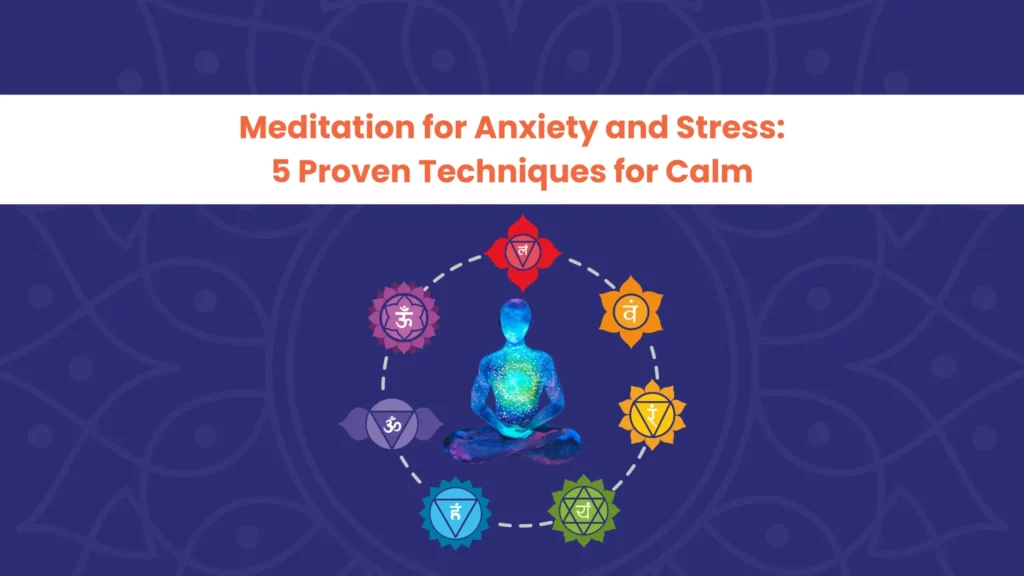
In traditional Indian metaphysics, emotional stress and anxiety are never viewed as purely psychological events. They are direct manifestations of blocked Prana (vital life-force energy) within your energetic anatomy. When you experience prolonged worry, the energy centers known as the Muladhara (Root Chakra) and the Anahata (Heart Chakra) become highly unstable.
[Chronic Worry/Fear] ──> [Chakra Malalignment (Root & Heart)] ──> [Erratic Prana Flow] ──>The Root Chakra governs your fundamental sense of survival, security, and stability. When it is starved of grounded energy, you experience a constant, floating sense of dread- a feeling that something is about to go terribly wrong. Similarly, an anxious Heart Chakra physically manifests as tightness in the chest, shallow breathing, and emotional volatility.
Practicing targeted meditation acts as a cosmic vacuum cleaner. It sweeps through these congested energetic pathways, re-aligns your subtle body, and creates a clean space where peace can flow freely into your waking consciousness.
The Neurobiology of Calm: The Science Behind Meditation
While the spiritual mechanics of meditation are beautiful, the physiological and neuroscientific impacts of practicing meditation for anxiety and stress are completely undeniable. Modern clinical research using fMRI scans reveals that sitting in silent meditation fundamentally remodels the physical structure of your brain.
Shrinking the Fear Center (The Amygdala)
The amygdala is the ancient, almond-shaped region of your brain responsible for triggering the “fight-or-flight” survival response. In chronically stressed individuals, the amygdala is structurally enlarged and hyper-reactive, treating a simple work email with the same existential panic as a tiger attack. Regular mindfulness meditation has been proven to structurally decrease the gray matter density of the amygdala, turning down your brain’s internal alarm system.
Vagus Nerve Activation and Cortisol Drop
When you practice rhythmic breathing or mantra chanting during meditation, you actively stimulate the vagus nerve. This massive nerve sends immediate signals to your heart, lungs, and digestive tract to switch off the sympathetic nervous system and engage the parasympathetic system. Your heart rate slows down, blood pressure normalizes, and the adrenal glands drastically reduce the production of cortisol (the primary stress hormone).
Also Read This :- “Vastu Tips for Business Growth: 7 Miraculous Secrets to Wealth”
5 Miracle Techniques of Meditation for Anxiety and Stress
Not every mind responds to the same practice. If sitting in blank silence makes your anxiety worse, try these five highly effective, distinct styles of meditation to discover what resonates with your soul.
Overview of Stress-Relief Meditation Practices
| Meditation Style | Core Mechanism | Best Financial / Lifestyle Match | Primary Mental Benefit |
| Pranayama (Anapana) | Breath observation and breath retention | Busy professionals, panic attack sufferers | Immediate grounding, aborts acute panic waves |
| Japa (Mantra) | Repetition of sacred sound frequencies | Chronically anxious overthinkers | Distracts the ego, breaks toxic thought loops |
| Yoga Nidra | Guided psychic sleep and body scanning | Insomniacs, severely fatigued individuals | Deep nervous system reset, mimics deep sleep |
| Trataka (Gazing) | Fixed point staring on a ghee lamp flame | Students, analytical professionals | Builds laser-focused attention, clears brain fog |
| Metta (Loving-Kindness) | Cultivating self-compassion and goodwill | People suffering from trauma or self-criticism | Dissolves deep inner guilt, heals raw emotions |
1. Japa Meditation: Breaking Loops via Sacred Sound
If your mind is hyperactive, give it a high-vibrational bone to chew on. Japa involves repeating a sacred sound column, such as Om Namah Shivaya or the Gayatri Mantra.
- Why it works: Your brain cannot focus on two complex thoughts simultaneously. By anchoring your awareness to a divine mantra, you mechanically crowd out anxious assumptions, replacing them with spiritual stability.
2. Yoga Nidra: The Ultimate Nervous System Reset
Often translated as “yogic sleep,” this practice involves lying flat on your back (Shavasana) while following a systematic verbal guide to scan your physical body for trapped tension.
- Why it works: Just 30 minutes of deep Yoga Nidra meditation has been clinically shown to offer the body the same physiological recovery as two hours of deep, dreamless sleep, making it an absolute lifesaver for people suffering from chronic insomnia.
Step-by-Step Guide to Starting Your Daily Practice
You do not need to pack your bags and head to the Himalayan caves to practice meditation for anxiety and stress. You can easily build a powerful, protected meditation ecosystem right inside your home.
[Cleanse Senses with Water] ──> [Sit facing North/East] ──> [Observe Breath or Mantra] ──Step 1: The Sanctuary: Pick a clean, quiet corner of your bedroom or living space. Dedicate this spot exclusively for meditation. Over time, this localized zone builds a serene energetic resonance, making it easier for you to drop into a meditative state the moment you sit down.
Step 2: The Posture: Sit comfortably on a firm cushion or a folded woolen mat. Keep your spine erect but completely relaxed. If you have lower back issues, you can sit firmly on a straight-backed chair with your feet resting flat on the ground.
Step 3: The Anchor: Close your eyes gently. Take three deep, slow belly breaths. Now, allow your breath to settle into its natural rhythm. Simply observe the cool air entering your nostrils and the warm air leaving them. Do not try to control it; just bear witness to it.
Step 4: The Return: Within seconds, your mind will drift away to your worries. When it does, do not judge, scold, or criticize yourself. Acknowledge the thought calmly, treat it like a passing cloud in the sky, and gently bring your focus back to your breath.
Common Pitfalls That Disrupt Mental Healing
Many well-meaning seekers begin their meditation journey with pure intentions but end up quitting within a couple of weeks because they run into these subtle psychological traps:
- Expecting Instant Enlightenment: Approaching meditation with a hyper-competitive, corporate mindset—“I sat silently for 10 minutes today, so my anxiety should be permanently gone by tomorrow” creates a secondary layer of stress. Meditation is a slow, evolutionary rewriting of your lifestyle habits.
- Fighting Against Thoughts: Trying to violently force your mind to become blank is like trying to wipe out waves in the ocean using a broom. The more you fight your thoughts, the more power you give them. Instead, learn to step back and observe them with detached curiosity.
- Inconsistent Practice Routines: Meditating for an hour on Sunday and then completely skipping your practice from Monday to Friday will yield minimal cumulative results. A regular, disciplined 10-minute session every single morning is vastly superior to sporadic, long sessions.
The Absolute Do’s and Don’ts for Anxious Minds
To preserve your mental space and maximize the emotional benefits of your meditation practice, observe these practical daily guidelines:
The Do’s:
- Do wash your face, hands, and eyes with cool water before sitting to practice to refresh your nervous system.
- Do light an organic oil lamp or diffuse natural lavender or sandalwood oil to cultivate a calming environmental trigger for your brain.
- Do show deep compassion to your mind on days when it feels unusually restless, noisy, or scattered.
The Don’ts:
- Never check your smartphone notifications, emails, or news feeds immediately after completing your meditation session; give your brain at least 15 minutes to absorb the calm.
- Never force your body into a painful, complex cross-legged lotus posture if it causes knee or spinal strain; physical pain completely blocks mental surrender.
- Avoid consuming heavy, oily, or highly processed meals immediately before meditating, as the digestion process will make your brain incredibly drowsy.
Myth vs. Reality: Debunking Meditation Misconceptions
Myth: Meditation is a religious ritual meant only for spiritual gurus or ascetics. Reality: Not at all. While meditation forms the spiritual backbone of ancient Indian traditions, it is a universal, secular science of attention training. Anyone, regardless of their religious faith or background, can safely practice it to heal their stress.
Myth: If my mind is thinking during meditation, it means I am failing completely. Reality: The nature of the brain is to secrete thoughts, just as the stomach secretes digestive enzymes. The fact that you noticed your mind wandering actually means your meditation is succeeding—you are developing mindfulness.
Conclusion: Rest Safely in Your Sacred Inner Sanctuary
When you introduce meditation for anxiety and stress into your daily schedule, you make a conscious decision to stop living like a hostage to your unpredictable external circumstances. You are not your racing thoughts; you are the silent, spacious awareness that observes those thoughts.
As you close your eyes tomorrow morning to begin your practice, leave the heavy burdens of the past and the scary assumptions of the future outside your door. Take a deep, deep breath. Trust that you are deeply supported by a magnificent cosmic intelligence. Step inside your inner sanctuary, find your center, and let the quiet power of meditation heal your soul. Peace is not a distant luxury; it is your divine birthright. Om Shanti, Shanti, Shanti.
Also Checkout This
- Naam Japa Counter
- What Is Naam Japa
- Importance of 108 in Japa
- Best Time for Mantra Chanting
- Maha Mrityunjaya Mantra
- Mantra Counter Online
How to Start Spiritual Journey for Beginners: Step-by-Step Guide | 2026
FAQ
Q1. Is it normal to feel more anxious when I first start meditating?
Ans. Yes, it is incredibly common. When you sit in silence for the first time, you are finally turning down the external noise of TVs, music, and phones. This allows you to clearly hear just how chaotic your subconscious mind has been all along. The meditation isn’t creating the anxiety; it is simply shining a light on it so it can finally be processed and healed.
Q2. What is the absolute best time of day to meditate for high stress?
Ans. The ideal window is during the Brahma Muhurta (between 4:00 AM and 6:00 AM) or right at sunset. During these transitional hours, the natural environment is quiet, and your brain’s cortisol levels are naturally resetting. However, if your schedule doesn’t permit this, meditating right before bed is an excellent alternative to release the accumulated mental residue of the workday.
Q3. How many minutes should a beginner spend on meditation daily?
Ans. Start small to ensure long-term consistency. Commit to just 5 to 10 minutes of daily practice for the first two weeks. Once your body adapts to sitting comfortably in silence, you can gradually extend the time by 5-minute increments until you find your personal sweet spot around 20 to 30 minutes.
Q4. Can children practice meditation for academic stress?
Ans. Yes, absolutely. Children as young as seven can benefit immensely from basic mindfulness practices. Instead of long silent sessions, teach them simple guided visualization games, brief breathing techniques (like Bhramari Pranayama or humming bee breath), or short mantra recitations to sharpen focus and relieve exam anxiety.
Q5. Should I keep my eyes completely open or fully closed while meditating?
Ans. For high anxiety, keeping your eyes gently closed is generally recommended because it blocks out 80% of external sensory distractions, allowing you to turn your focus inward. However, if closing your eyes triggers intense intrusive thoughts or drowsiness, you can keep them slightly open with a soft, unfocused gaze downward toward the floor.
Q6. Can meditation completely cure my clinical anxiety disorder?
Ans. Meditation is an extraordinarily powerful clinical tool that significantly lowers stress hormones and down-regulates hyperactive emotional responses. However, for severe, clinical anxiety conditions, it should be utilized as a holistic lifestyle support system alongside proper psychological counseling, medical advice, and guidance from healthcare professionals.
Q7. Can I meditate while lying down in bed if I have physical pain?
Ans. Yes, you can. If chronic pain, spinal conditions, or high physical fatigue makes sitting upright impossible, you can lie flat on your back in the corpse pose (Shavasana). Keep your hands flat at your sides and stay alert. The only risk of meditating while lying down is that your brain may associate the posture with sleep and drift off, which can be managed by maintaining conscious focus on your breath.