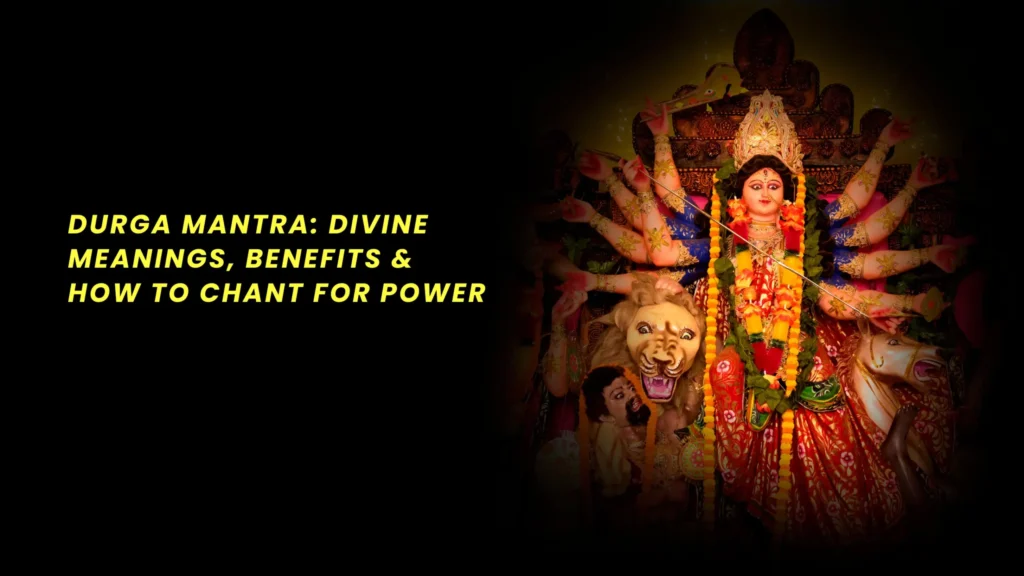
Have you ever stood before the magnificent, radiant idol of Maa Durga during the celebratory nights of Navratri? Watching her compassionate yet fiercely protective eyes under the warm glow of a camphor flame, you might feel an involuntary shiver of raw devotion run down your spine. In that single, breathtaking moment, as the rhythmic beat of the dhak echoes around you, the overwhelming burdens of your daily life- whether it is financial anxiety, career blocks, or lingering self-doubt- suddenly seem to shrink into nothingness.
In our chaotic modern world, we frequently find ourselves entirely defenseless against toxic environments, malicious workplace politics, and deep internal emotional blockages. When life begins to feel like a constant, draining battleground, where do you go to reclaim absolute protection and unshakable resilience? The ancient seers of India discovered that the ultimate shield lies hidden inside the sound science of the Durga mantra.
Far from being mere cultural songs or religious poems, these sacred sound frequencies act as intense cosmic keys. They systematically restructure your nervous system, dismantle negative planetary blockages, and draw down the absolute grace of the Invincible Mother. In this premium guide by TemplePedia, we will break down the foundational mantras of Maa Durga, their deep psychological and scientific profiles, and the precise traditional methods to execute your sadhana flawlessly.
Table of Contents
The Spiritual Legacy of the Cosmic Mother
To tap into the life-altering currents of a Durga mantra, one must first understand the structural cosmic blueprint of the deity who commands it. The Puranas record that when the terrifying, shapeshifting demon Mahishasura defeated the celestial forces and cast them out of heaven, no individual deity could withstand his onslaught. In absolute surrender, Lord Brahma, Lord Vishnu, and Lord Shiva merged their primeval cosmic fires. From this dazzling, unified cosmic blaze emerged Maa Durga—the ultimate collective matrix of universal power, or Shakti.
The literal Sanskrit translation of the word Durga means “a fortress that cannot be breached” or “she who is untamable and eliminates all suffering”. Therefore, when you invoke her through a seed syllable or mantra, you are not addressing an external anthropomorphic entity; you are activating an unbreachable energetic armor around your own psychological field.
By aligning your voice with her cosmic frequencies, you tap into a thousands-of-years-old spiritual reservoir that clears the path of spiritual illusion (Maya) and awakens the sleeping warrior spirit within your soul.
Also Read This:- 108 Names of Goddess Durga With Meaning: Invoke the Miraculous Power of the Cosmic Mother
Maha Mrityunjaya Mantra: Meaning, Benefits & How to Chant
Core Durga Mantras: Translation & Deep Meaning
Different compositions evoke different aspects of the Divine Mother’s energy. Depending on whether you seek peace, protection, or the removal of heavy financial debts, choose one of these primary, highly potent mantras to begin your practice:
1. The Foundational Durga Navarna Mantra
This is the supreme, crown-jewel mantra of the Devi Mahatmyam, packing the combined elemental forces of the cosmic trinity (Maa Saraswati, Maa Lakshmi, and Maa Kali) into a singular sonic column.
Om Aing Hreem Kleem Chamundaye Viche
Aing{ऐं}: The Beeja (seed) syllable of Maa Saraswati. It purifies the mind, sharpens memory, activates higher cognitive brilliance, and governs wisdom.
Hreem {ह्रीं}: The seed syllable of Maa Lakshmi. It clears financial blockages, attracts material stability, and removes cosmic illusion.
Kleem {क्लीं}: The seed syllable of Maa Kali. It cuts through deep-seated fears, destroys toxic external entities, and ignites absolute inner strength.
Chamundaye Viche {चामुण्डायै विच्चे}: “O slayer of the toxic demons Chanda (passion) and Munda (anger), untie the knots of my ignorance and liberate my soul”.
The Durga Dhyana Mantra
Ideal for daily invocation, morning meditation, and tuning your space for positivity before starting work chores.
Om Dum Durgaye Namaha
- Meaning: “Om, I bow down with deep love, humility, and absolute surrender to the Invincible Mother Durga”.
- Spiritual Value: The syllable Dum {दुं} acts like a sonic vacuum cleaner, sweeping through the congested pathways of your subconscious mind to crowd out intrusive thoughts and replace them with spiritual security.
The Sarva Mangala Mangalye Sloka
A beautiful, highly protective verse chanted across millions of traditional Indian homes to attract instant good luck and family harmony.
Sarva Mangala Mangalye Shive Sarvartha Sadhike
Sharanye Tryambake Gauri Narayani Namostute
- Meaning: “O auspicious mother of all things auspicious, the consort of Lord Shiva, she who fulfills every single pure desire of her devotees. I seek ultimate shelter under your three-eyed radiant form, O Gauri, O Narayani, I bow to you down endlessly”.
The Bio-Resonance Science Behind Sound Healing
Many analytical, modern thinkers question if repeating a Durga mantra yields practical benefits beyond emotional sentiment. However, through the lenses of neuroscience, bio-physics, and psycholinguistics, Sanskrit operates as an exceptionally precise phonetic engineering science.
      [Sanskrit Syllable Chanted] ➔ Tongue Strikes Upper Palate Meridians
                                           ↓
                 Stimulates Pituitary, Pineal, & Vagus Nerve Systems
                                           ↓
            Transitions Brainwaves from Beta (Anxious) to Alpha (Calm)
                                           ↓
                 Lowers Cortisol & Rebuilds Neuroplastic Coherence
When you rhythmically pronounce hard dental and nasal tones like Dum, Hreem, or Chamundaye, your tongue actively strikes highly specific pressure points on the roof of your upper palate. This structural rhythmic movement triggers immediate impulses in the pituitary and pineal glands, signaling the brain to enter a state of heightened neuroplasticity.
Simultaneously, the prolonged humming vibration generated in your throat stimulates the Vagus Nerve- the primary driver of your parasympathetic nervous system. Activating the vagus nerve lowers your heart rate, curbs excessive cortisol (stress hormone) production, and neutralizes full-body cellular inflammation.
From a physics perspective, this is a clear demonstration of entrainment. Chanting systematically raises your body’s personal vibrational frequency, allowing a chaotic, survival-driven mind to rise up and lock into a state of neural coherence and laser-focused concentration.
Life-Altering Benefits of Dedicated Chanting
Committing to a steady daily practice of a chosen Durga mantra fundamentally alters how your energy body interacts with the material world. Expect these tangible breakthroughs over months of steady devotion:
| Area of Life Impact | Immediate Practical Benefit | Long-Term Transformation |
| Mental & Emotional | Sudden reduction in overthinking, relief from panic loops. | Mastery over sudden emotional triggers, deep permanent calm. |
| Financial & Career | Sharp clarity during high-pressure negotiations and decisions. | Removal of debts, discovering lucrative life opportunities. |
| Physical Wellness | Deep respiratory stabilization, lowering of blood pressure. | Cellular purification, enhanced stamina, robust immunity. |
| Spiritual Aura | Building an invisible energetic firewall against negative eyes. | Activation of the Third-Eye (Ajna) chakra, high intuition. |

How Many Times Should a Mantra Be Chanted Daily?
Step-by-Step Guide: How and When to Chant
To convert a Durga mantra into a dynamic energy vortex within your living room, avoid mechanical or casual recitation. Approach it with intentional structure:
- The Auspicious Window: The ideal time is during the early morning hours of Brahma Muhurta (4:00 AM to 6:00 AM) or during the evening twilight window (Sandhya Kaal). Chanting on auspicious Tuesdays, Fridays, or during the high-vibrational periods of Navratri amplifies the energy field tenfold.
- The Altar Geometry: Choose a quiet corner and set up a clean, raised wooden platform. Drape a fresh, rich red cloth over it and place an idol or image of Maa Durga facing your seat.
- The Sitting Posture: Sit comfortably on a clean mat made of wool or cotton. Keep your spine completely straight but relaxed, allowing your life-force energy (Kundalini shakti) to flow smoothly upward from your root chakra to the crown chakra.
- The Element Offerings: Light a pure ghee or sesame oil lamp and an organic incense stick. Offer a few fresh red flowers (like hibiscus or roses), which carry a high vibrational frequency that naturally aligns with the Mother’s energy.
- The Count Process: Use an authentic 108-bead Rudraksha mala to track your repetitions. Hold the beads using your right hand’s thumb and middle finger, keeping your index finger (representing the individual ego) away from the string.
- Bhava (Emotional Resonance): This is the ultimate component. Do not just mumble words mechanically. Close your eyes, visualize her brilliant form standing protectively in front of you, and chant with a heart completely full of love, trust, and surrender.
Common Pitfalls to Sidestep During Your Sadhana
Many well-meaning practitioners sit down to chant for months but complain that nothing shifts inside their lifestyle. Frequently, they fall into these common traps:
Rushing Like a To-Do List Checklist
Mumbling through your 108 repetitions at breakneck speed just to quickly get back to checking your smartphone notifications completely breaks the delicate acoustic geometry of the hymn. Slow down, enjoy the pronunciation of each syllable, and allow the echo of the sound to settle deeply into your subconscious mind.
The Transactional Greed Mindset
Approaching a cosmic mother with a narrow, hyper-competitive, corporate mindset—“I will trade 108 chants today if you give me a lottery win or a workspace promotion tomorrow”—chokes off the flow of genuine devotion. Chant with surrender, allowing her energy to clear your inner blocks first.
Internal Behavioral Inconsistency
Building up a powerful, clean energetic charge at your altar on Tuesday morning, and then engaging in toxic workplace gossip, lying, or treating family members with severe cruelty on Wednesday completely neutralizes the positive spiritual momentum you accumulated. Let the sweetness of the mantra reflect in your daily speech.
The Sacred Checklist of Do’s and Don’ts
To keep your personal spiritual ecosystem pristine and preserve the delicate energy fields you generate, print out this quick boundary reference guide:
The Do’s:
- Do attempt to chant at the exact same clean spot and time every day to establish a localized spiritual vortex in your home.
- Do practice whispering (Upamsu Japa) or silent mental chanting (Manasa Japa) when commuting or around others, as mental repetition is exceptionally powerful for deep clearing.
- Do maintain physical cleanliness by rinsing your mouth and washing your face, hands, and feet before stepping near the altar.
- Do keep your Japa mala reverently tucked away inside a dedicated cotton pouch when it is not in active use.
The Don’ts:
- Never use a divine mantra with a heart full of malice, jealousy, or a desire to wish negative outcomes upon anyone else; it will severely backfire on your own karmic timeline.
- Never leave your sacred beads lying casually on the dirty floor or scattered across a messy bed.
- Never keep torn pictures or heavily cracked metallic idols in your temple room; immerse them with respect in a natural flowing river.
- Avoid consuming heavy, toxic, or highly processed oily foods immediately before sitting down to chant, as digestion will make your mind drowsy and sluggish.

Why Monday Is Important for Shiva Devotees?
Myth vs. Reality: Overcoming Fear-Based Misconceptions
Let us debunk a few commercial, fear-mongering myths propagated by pseudo-experts so you can step into your practice with total confidence and peace of mind:
Myth: Maa Durga is incredibly short-tempered, and if I accidentally mispronounce a single Sanskrit letter, some terrible curse will fall upon my family.
Reality: This is an entirely false, fear-based misconception. Maa Durga is Jagadamba—the loving, ultimate cosmic mother of all creation. In the path of pure devotion (Bhakti), the divine looks deeply into your internal intent, love, and emotional purity, not your linguistic perfection. Learn the correct pronunciation as best as you can, but chant with a relaxed, loving heart!
Myth: Women must completely stop thinking about or mentally reciting a Durga mantra during their monthly menstrual cycle.
Reality: No divine sound current can ever be made impure by a natural biological cycle designed by the Mother herself. Sincere mental chanting can and should be safely practiced anywhere, anytime. However, to allow the physical body to rest comfortably during heavy flow days, traditional customs simply recommend taking a brief break from sitting at the formal family altar setup.
Conclusion: Standing Strong in the Fortress of Shakti
In the final analysis, integrating a Durga mantra into your daily routine is a conscious decision to stop living in defensive, anxious survival mode. You are not a helpless leaf blowing around in the unpredictable wind of harsh external circumstances. You carry a spark of the absolute creator within your own chest cavity, and sacred sound is the dynamic key that unlocks that hidden treasury.
As you conclude your daily practice tomorrow morning, let a quiet wave of peace wash over your soul. Visualize her golden lion guarding your front door and her shining trident cutting down your deepest anxieties. Stand tall, work with total integrity, and let the magnificent power of the Cosmic Mother pave your clear path toward victory, abundance, and eternal joy. Om Dum Durgaye Namaha.
Questions and Answers !
Q1. Can I read a Durga mantra from a smartphone or digital screen?
Yes, absolutely. In the initial stages of your practice, using a book or smartphone to memorize the syllables correctly is perfectly fine. As you progress over a few weeks, try to slowly memorize the lines so you can close your eyes and focus fully inward.
Q2. Is it mandatory to use a specific counting mala for these names?
No, using a counting mala is not strictly mandatory, especially if you are reading fixed texts like the Durga Ashtottara Shatanamavali (108 names), which naturally fulfill the sacred count from start to finish. However, for short seed mantras like “Om Dum Durgaye Namaha”, a Rudraksha mala helps anchor your attention.
Q3. How long does it take to see tangible shifts in life after starting?
Spiritual purification happens in gradual layers. While many devotees notice an immediate drop in daily anxiety and an influx of mental clarity within 11 days, major career turnarounds and the removal of heavy, long-standing obstacles show up clearly within 40 to 90 days of steady devotion.
Q4. Can a non-vegetarian person chant a Durga mantra?
Yes, anyone can safely begin this practice, as sincere devotion is the greatest medicine to naturally purify inner desires over time. As your body’s cellular vibration rises through the power of the sound, your cravings for toxic habits and heavy lifestyles will naturally fall away on their own.
Q5. What is the difference between chanting in the morning versus the evening?
Morning chanting during the Brahma Muhurta fills your biological system with sharp focus, vibrant solar energy, and mental stamina to tackle career challenges. Evening chanting acts as a beautiful reset, wiping away the cumulative stress, negative workplace vibes, and mental exhaustion of the day to ensure peaceful sleep.
Q6. Can I chant these protective mantras for the health and safety of my children?
Yes, unequivocally. Maa Durga is the universal mother. Praying to her and dedicating the spiritual energy of her mantras for your children invokes her supreme protective shield (Raksha Kavach) around them, guarding them from accidents and negative influences.
Q7. Should I chant the names silently or loudly?
Both methods possess unique values. Loud chanting (Vaikhari) is excellent for absolute beginners as it easily blocks out external environmental noise and forces a wandering mind to stay anchored. Silent mental chanting (Manasa Japa) is considered highly advanced, working directly on the deep subconscious layers of your mind.